Fundamental
Prepare and test your skills

Fundamental
Prepare and test your skills
Serverless Scaling With Maximum Instance Limits
Free sample question with answers and detailed explanation below. The Cloud Digital Leader practice bank has an additional 3,070 practice questions.Try 10 free realistic questions: instant score, no credit card, and no account required.
A retail organization is designing the cloud architecture for a new event-driven order processing application. During planning, the architecture and finance teams establish the following constraints:
- Traffic and performance: The workload experiences fluctuating demand with sudden traffic spikes during sales events, followed by long periods of near-zero activity.
- Cost management: The company wants to avoid paying for idle compute capacity when demand is low, while enforcing a strict ceiling on maximum compute spend during peak periods.
- Operational control: The development team wants to minimize operational overhead by eliminating the need to manage underlying operating systems or provision virtual machines.
Which Google Cloud compute option and configuration best addresses these constraints?
Explanations
Deploy the application on Compute Engine sole-tenant nodes with CPU overcommit enabled
Deploy the application on Compute Engine sole-tenant nodes with CPU overcommit enabled
What Compute Engine sole-tenant nodes with CPU overcommit are
Sole-tenant nodes are dedicated physical Compute Engine servers reserved exclusively for a single organization's virtual machines, preventing hardware sharing with other cloud customers. CPU overcommit is a sole-tenant configuration feature (adjustable between 1.0 and 2.0) that allows VMs on the dedicated node to share physical CPU resources and burst above their baseline allocation.
Why it doesn't meet the requirements
- Cost management: Provisioning sole-tenant nodes requires paying for entire dedicated physical hosts regardless of how few requests the application is processing. During long periods of near-zero activity, the organization would incur high ongoing costs for dedicated hardware sitting idle.
- Operational control: Managing sole-tenant nodes involves high operational complexity, including configuring node types, setting overcommit ratios, defining host maintenance policies, and administering all guest VMs and operating systems.
Key characteristics and limitations
- Dedicated physical hardware: Isolates workloads from other projects and tenants at the physical server layer.
- License optimization: Supports bring your own license (BYOL) models for software bound to physical cores, such as Windows Server.
- High fixed cost and administration: Requires careful capacity planning and cluster sizing rather than effortless, pay-per-request serverless scaling.
This answer would be correct if
This configuration would be ideal if the organization needed to migrate enterprise Windows Server workloads with existing per-core BYOL agreements or strict regulatory hardware isolation mandates, where the VMs are generally underutilized on the dedicated host but occasionally need to burst CPU usage.
Additional context
While CPU overcommit improves resource density on dedicated physical hosts for bursty virtual machines, it operates within the fixed capacity of provisioned sole-tenant nodes and does not eliminate baseline hardware costs or OS management overhead.
Deploy the application on Compute Engine using Spot VMs and custom machine types
Deploy the application on Compute Engine using Spot VMs and custom machine types
What Compute Engine Spot VMs and custom machine types are
Spot VMs are highly discounted, ephemeral Compute Engine virtual machine instances that utilize spare Google Cloud capacity, which Google Cloud can reclaim at any time if the capacity is needed elsewhere. Custom machine types allow administrators to tailor the exact number of vCPUs and amount of memory for a VM to match specific workload profiles and avoid overprovisioning.
Why it doesn't meet the requirements
- Traffic and performance reliability: Because Spot VMs are ephemeral resources that can be preempted with minimal notice, they cannot guarantee continuous availability or predictable performance for a customer-facing order processing system during critical sales events.
- Operational control: Both Spot VMs and custom machine types are features of Compute Engine, meaning the development team must still configure, patch, and manage virtual machines and operating systems rather than offloading infrastructure management.
Key characteristics and limitations
- Ephemeral availability: Instances can be terminated whenever Google Cloud requires the underlying compute capacity for standard workloads.
- No uptime guarantees: Unsuitable for stateful or customer-facing applications that cannot tolerate sudden interruptions.
- Infrastructure management overhead: Requires teams to build fault-tolerant recovery logic as well as manage VM images and operating systems.
This answer would be correct if
This solution would be appropriate if the company needed to run non-critical, fault-tolerant batch processing jobs or experimental development workloads with unusual CPU-to-memory ratios, where low cost is the primary objective and sudden instance preemption is acceptable.
Additional context
In a well-architected cloud environment, Spot VMs are paired with stateless, fault-tolerant processing pipelines or sandbox testing environments, whereas customer-facing, event-driven applications rely on managed serverless platforms like Cloud Run for reliable, instant scaling.
Deploy the application on Cloud Run and configure autoscaling with maximum scaling limits
Deploy the application on Cloud Run and configure autoscaling with maximum scaling limits
What Cloud Run with autoscaling is
Cloud Run is a fully managed serverless compute platform that enables teams to run containerized applications without provisioning, configuring, or maintaining underlying virtual machine infrastructure. By combining Cloud Run with built-in autoscaling and maximum scaling limits, organizations can dynamically adjust compute capacity in real time based on incoming requests or events.
How it meets the requirements
- Traffic and performance: As an event-driven workload with fluctuating demand, Cloud Run automatically provisions additional container instances within seconds to handle sudden traffic spikes, maintaining predictable performance during sales events.
- Cost management: When traffic drops, Cloud Run scales down dynamically so the organization does not incur compute costs when the load is low. Configuring maximum scaling limits places a hard cap on the number of active instances, ensuring that unexpected traffic surges do not cause cloud spending to exceed specified budgets.
- Operational control: Because Cloud Run is a serverless service, Google Cloud handles all operating system patching, server provisioning, and underlying runtime maintenance, allowing developers to focus entirely on application code.
Cloud Run Scales Up, Caps, Then to Zero
Timeline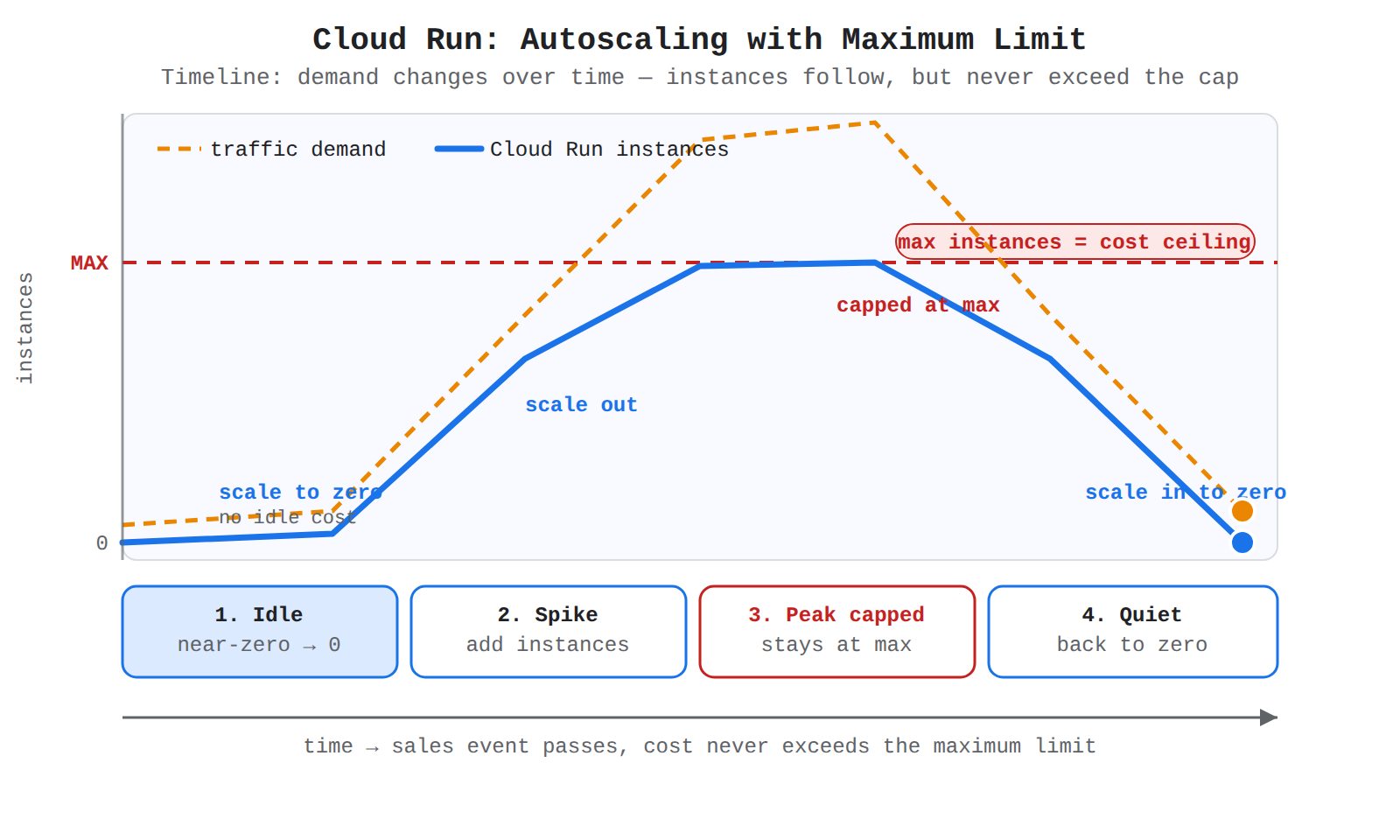
Key advantages and capabilities
- Consumption-based billing: Aligns operational expenditure directly with actual demand rather than fixed server capacity.
- Zero infrastructure management: Eliminates the long-term operational burden of managing virtual machines, hypervisors, or cluster nodes.
- Granular budget protection: Enforces financial boundaries through configurable maximum scaling limits.
- Rapid elasticity: Scales seamlessly from zero to peak capacity in response to real-time event triggers.
Why this is optimal
Compared to virtual machine-based solutions like Compute Engine, Cloud Run removes the operational overhead of OS management and prevents paying for idle, overprovisioned capacity. It provides the ideal balance between dynamic performance, strict cost governance, and minimal operational complexity for event-driven workloads.
Deploy the application on Compute Engine using a 3-year resource-based committed use discount (CUD)
Deploy the application on Compute Engine using a 3-year resource-based committed use discount (CUD)
What Compute Engine with a 3-year resource-based CUD is and does
Compute Engine is an Infrastructure as a Service (IaaS) offering that provides configurable virtual machines (VMs) with full control over the operating system and runtime environment. A 3-year resource-based committed use discount (CUD) is a pricing model that provides a deep discount on specific Compute Engine resources in a designated region in exchange for a three-year contract.
Why it doesn't meet the requirements
- Cost management for fluctuating traffic: A resource-based CUD requires committing to a fixed minimum amount of vCPUs and memory payable monthly over three years, regardless of whether the resources are utilized. For a spiky workload with long periods of near-zero activity, the organization would continually pay for idle capacity.
- Operational control: Running workloads on Compute Engine requires the engineering team to manage the guest operating system, configure VM instances, and handle runtime updates, which directly contradicts the goal of eliminating server management.
Key characteristics and limitations
- Fixed regional commitment: Locks the organization into a specific resource allocation within a chosen Google Cloud region for a three-year term.
- Predictable monthly billing: Billed monthly in USD based on the committed capacity rather than dynamic, event-driven usage.
- High operational responsibility: Requires ongoing administration of virtual machines, storage disks, and networking configurations.
This answer would be correct if
This option would be the right choice if the organization were migrating a predictable, steady-state production workload that runs continuously at stable utilization levels in a single region, and the engineering team required granular operational control over the underlying operating system to achieve the lowest long-term total cost of ownership (TCO).
Additional context
While Compute Engine also offers flexible CUDs that apply across multiple machine types and regions based on hourly spend, any committed use discount is fundamentally designed for baseline, steady-state consumption rather than highly erratic, event-driven workloads.
Try 10 interactive questions like this one, free
Answer them yourself and get your score the moment you finish. No account needed.
Full access includes
- 3,070 practice questions across all 6 exam domains
- Every answer explained: why it is right, and why the others are not
- Scout, an AI tutor that answers your follow-up questions
- Readiness tracking by domain, so you know when to book the exam
Related free sample questions
Keep the momentum going with these hand-picked practice scenarios
FundamentalCloud Digital Leader
Cloud Armor Edge DDoS Mitigation
Describe how an organization can protect against network attacks using Google products, including distributed denial-of-service (DDoS) using Google Cloud Armor.
FundamentalCloud Digital Leader
Data Bias Metrics Pre-Training Audit
Discuss the importance of explainable and responsible AI
FundamentalCloud Digital Leader
Real-Time Clickstream Analytics Personalization
Explain how data generates business insights, drives decision-making, and creates new value.
FundamentalCloud Digital Leader
Toil Reduction and Blameless Postmortems
Define important cloud operations terms.
FundamentalCloud Digital Leader
Google Cloud Trust and Sustainability Benefits
Describe the main business transformation benefits of Google Cloud: intelligence, freedom, collaboration, trust, and sustainability.
AdvancedProfessional Cloud DevOps Engineer
Structured Logging and Tail-Based Sampling
Observability issues
Last updated