Fundamental
Prepare and test your skills

Fundamental
Prepare and test your skills
Retain Restricted Workloads and Retire Redundant Ones
Free sample question with answers and detailed explanation below. The Cloud Digital Leader practice bank has an additional 3,070 practice questions.Try 10 free realistic questions: instant score, no credit card, and no account required.
An organization is assessing its on-premises inventory to build a Google Cloud migration plan and identifies two specific workloads:
- Workload A: A mission-critical database with strict software licensing terms that forbid running in a public cloud, though its data must remain accessible to new cloud applications.
- Workload B: An outdated reporting application running on end-of-life software whose functionality is already provided by another tool in the organization.
Which strategic migration decisions should the organization make for these workloads?
Explanations
Retire Workload A by moving it to a SaaS platform, and retain Workload B as a first-mover migration candidate
Retire Workload A by moving it to a SaaS platform, and retain Workload B as a first-mover migration candidate
What These Options Do
This option confuses foundational migration terms by misapplying both retire and retain. Moving from an on-premises application to a cloud-hosted Software-as-a-Service (SaaS) equivalent is actually a repurchase strategy, whereas retiring a workload means decommissioning it completely because its capabilities are no longer required. Similarly, selecting a workload as a first-mover means actively migrating it to Google Cloud in the initial batch, which is the opposite of retaining it in the source environment.
Why It Doesn't Meet the Requirements
- Fails Workload A requirements: Workload A is a mission-critical database whose data is actively needed by new cloud applications, so it cannot simply be shut down and retired. Furthermore, replacing it with a SaaS product does not match the definition of retiring a workload.
- Fails Workload B requirements: Workload B is redundant and built on end-of-life technology. Migrating an obsolete, rarely needed tool as a first-mover wastes engineering effort and fails to build useful migration momentum or reusable patterns for the rest of the organization.
Key Characteristics and Limitations
- Repurchase vs. Retire: A repurchase replaces an existing system with a commercial SaaS offering (such as moving to Google Workspace), while retire permanently turns off an unneeded workload without migrating it.
- Retain vs. First-Mover: A retained workload stays on-premises or in its original hosting environment, whereas a first-mover is a carefully chosen, low-risk workload migrated first to help teams build Google Cloud skills.
- Poor first-mover selection: Obsolete or rarely used applications make poor first-movers because they do not reflect common architectural patterns across the organization.
This Answer Would Be Correct If
Moving to a SaaS platform would be the right choice if the organization wanted to repurchase a standard collaboration or CRM tool rather than maintain it on-premises. Selecting a workload as a first-mover would be appropriate if the workload were actively used, non-mission-critical, loosely coupled, and representative of common development patterns.
Retain both workloads in the on-premises data center permanently, and rebuild both applications from scratch in Google Cloud
Retain both workloads in the on-premises data center permanently, and rebuild both applications from scratch in Google Cloud
What Rebuild and Permanent Retention Do
A rebuild migration (sometimes referred to as remove and replace or rip and replace) involves decommissioning an existing legacy application and completely redesigning and rewriting it from scratch as a cloud-optimized workload on Google Cloud. Combining a full rebuild with permanently retaining the original workloads on-premises means running duplicate systems across both environments indefinitely.
Why It Doesn't Meet the Requirements
- Creates unnecessary duplication for Workload A: Workload A only needs to remain on-premises because of its third-party software license, and its data can be accessed via a hybrid architecture. Simultaneously keeping Workload A on-premises and rebuilding it from scratch in the cloud creates massive data synchronization complexity and redundant infrastructure costs.
- Rebuilds an unneeded system for Workload B: Workload B's functionality is already provided by another existing application in the organization. Keeping the end-of-life version running on-premises while also spending months rewriting a duplicate reporting tool in Google Cloud contradicts core cloud cost-optimization principles.
Key Characteristics and Limitations
- High effort and duration: A rebuild takes longer than rehost, replatform, or refactor migrations because engineering teams must design, write, and test an entirely new codebase.
- Decommissioning expectation: In a standard rebuild strategy, the legacy on-premises application is decommissioned once the cloud-native replacement is deployed, rather than retained permanently.
- Increased operational complexity: Running redundant legacy and cloud-native versions of the same workloads increases maintenance overhead and total cost of ownership (TCO).
This Answer Would Be Correct If
Rebuilding from scratch would be the right choice if an application were still essential to the business, had no existing replacement, and was too outdated or costly to maintain or migrate—provided the legacy version was decommissioned after cutover rather than retained permanently.
Retain Workload A on-premises with a hybrid integration, and retire Workload B so it is excluded from the migration scope
Retain Workload A on-premises with a hybrid integration, and retire Workload B so it is excluded from the migration scope
What the Retain and Retire Strategies Are
During the assessment phase of a cloud migration, organizations evaluate every workload—an independent application, service, or computing task that delivers business value—to determine its optimal path forward. Not every workload in an on-premises inventory should be moved to the cloud. Retain means keeping a workload in its current source environment (either temporarily or permanently), while retire means decommissioning and shutting down a workload that is no longer needed.
Retain vs Retire Decision Tree
Decision Tree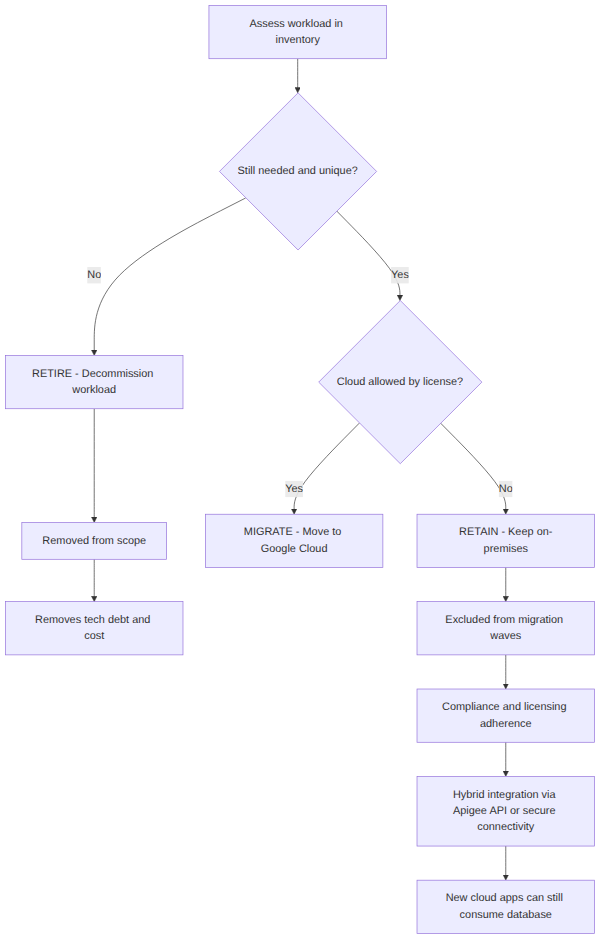
How It Meets the Requirements
- Addressing Workload A (Retain): Workload A is bound by strict third-party licensing restrictions that legally prohibit running the software in a public cloud environment. Retaining this database on-premises ensures full compliance while allowing the organization to use a hybrid cloud architecture (such as an API management platform like Apigee or secure network connectivity) so cloud-based applications can still consume its critical data.
- Addressing Workload B (Retire): Workload B relies on end-of-life technology and provides redundant functionality that is already covered by another application. Decommissioning (retiring) this workload removes unnecessary technical debt and eliminates the effort of migrating an obsolete tool.
Key Advantages and Capabilities
- Reduced migration scope and cost: Retiring redundant workloads shrinks the inventory of systems that must be grouped into migration batches, saving time and money.
- Compliance and licensing adherence: Retaining restricted workloads prevents costly legal or vendor licensing violations during cloud adoption.
- Lower operational overhead: Eliminating end-of-life applications removes ongoing maintenance, patching, and licensing expenses.
- Seamless hybrid continuity: Retaining critical systems alongside API or network integrations unlocks legacy data for modern cloud workloads without forcing an unsupported move.
Why This Is Optimal
Making strategic retain and retire decisions early in the assessment phase shapes the entire migration plan and timeline. Compared to forcing every legacy system into a lift-and-shift or refactoring batch, filtering out workloads that cannot move or should not exist allows engineering teams to focus their resources on workloads that deliver genuine business value in Google Cloud.
Rehost Workload A to Google Cloud with minimal changes, and refactor Workload B to modernize its underlying codebase
Rehost Workload A to Google Cloud with minimal changes, and refactor Workload B to modernize its underlying codebase
What Rehost and Refactor Do
Rehost (commonly referred to as lift and shift) and refactor (often called move and improve) are active migration pathways used to move workloads into Google Cloud. In a rehost migration, an organization moves a workload from a source environment to a target environment with minimal or no code modifications. In a refactor migration, teams modify and optimize the application's code and configuration to take advantage of cloud-native capabilities such as elastic scalability and high availability.
Why It Doesn't Meet the Requirements
- Violates Workload A constraints: Rehosting moves Workload A directly into a public cloud environment (such as Compute Engine virtual machines). Because Workload A has strict licensing terms that explicitly forbid public cloud deployment, lifting and shifting it would result in a direct licensing and compliance violation.
- Wastes resources on Workload B: Refactoring requires significant time, new skills, and engineering effort to rewrite or restructure code. Investing that effort into an end-of-life reporting tool whose capabilities are already duplicated by another application wastes budget and delays the overall migration timeline.
Key Characteristics and Limitations
- Rehost (Lift and Shift): Fastest migration method with minimal changes, ideal for working workloads with few dependencies, but still requires the workload to be legally and technically permitted in the cloud.
- Refactor (Move and Improve): Improves performance, portability, and cloud efficiency, but requires substantial engineering effort and testing compared to rehosting.
- Dependency on business value: Neither rehosting nor refactoring should be applied to redundant workloads that provide no unique business value.
This Answer Would Be Correct If
This approach would be appropriate if Workload A had cloud-friendly licensing and needed to move quickly to Google Cloud with minimal code changes, and if Workload B were a valuable, actively used core application that required code updates to run efficiently in a cloud environment.
Try 10 interactive questions like this one, free
Answer them yourself and get your score the moment you finish. No account needed.
Full access includes
- 3,070 practice questions across all 6 exam domains
- Every answer explained: why it is right, and why the others are not
- Scout, an AI tutor that answers your follow-up questions
- Readiness tracking by domain, so you know when to book the exam
Related free sample questions
Keep the momentum going with these hand-picked practice scenarios
FundamentalCloud Digital Leader
Replatform vs Rehost Migration
Define the main cloud migration terms, including: workload; retire; retain; rehost; lift and shift; replatform; move and improve; refactor; reimagine.
FundamentalCloud Digital Leader
Refactor vs Rehost Migration Strategy
Define the main cloud migration terms, including: workload; retire; retain; rehost; lift and shift; replatform; move and improve; refactor; reimagine.
FundamentalCloud Digital Leader
Compliance Resource Center
Describe how Google Cloud compliance resource center and Compliance Reports Manager support industry and regional compliance needs.
FundamentalCloud Digital Leader
Low CO2 Regions and Active Assist Recommender
Discuss how Google Cloud helps organizations meet sustainability goals and reduce environmental impact.
FundamentalCloud Digital Leader
AI vs ML Relationship
Define artificial intelligence (AI) and machine learning (ML).
AdvancedProfessional Cloud DevOps Engineer
GMP ClusterPodMonitoring Metric Relabeling Drop
Collecting metrics (e.g., from applications, platforms, networking, Cloud Service Mesh, Google Cloud Managed Service for Prometheus, hybrid/multi-cloud environments)
Last updated