Fundamental
Prepare and test your skills
Fundamental
Prepare and test your skills
BigQuery Omni Multicloud In-Place Analytics
Free sample question with answers and detailed explanation below. The Cloud Digital Leader practice bank has an additional 3,070 practice questions.Try 10 free realistic questions: instant score, no credit card, and no account required.
A retail enterprise stores petabytes of historical transaction data in Amazon S3 and Azure Blob Storage while running its primary analytics workloads in Google Cloud. The company wants to analyze the data stored in these external clouds using standard GoogleSQL queries, subject to the following requirements:
- Avoid outbound data transfer (egress) fees for moving raw datasets across cloud providers.
- Keep the raw data in its original external cloud storage locations to satisfy strict data governance policies.
- Eliminate the need to provision or manage additional compute clusters in the external clouds.
How does BigQuery Omni help the enterprise meet these requirements?
Explanations
By using the BigQuery Data Transfer Service to replicate the raw tables into standard BigQuery storage on an automated schedule without incurring transfer costs
By using the BigQuery Data Transfer Service to replicate the raw tables into standard BigQuery storage on an automated schedule without incurring transfer costs
What the BigQuery Data Transfer Service does
The BigQuery Data Transfer Service is a fully managed data movement tool designed to automate the ingestion and replication of data into standard BigQuery tables on a scheduled basis. It connects to a wide variety of external data sources—including software-as-a-service (SaaS) applications and external cloud storage—to streamline data migration and centralize storage within Google Cloud.
Why it doesn't meet the requirement
Using a transfer service to replicate raw tables into Google Cloud physically moves the data out of its original environment, which violates the enterprise's strict data governance policies. Additionally, copying petabytes of raw data out of Amazon S3 or Azure Blob Storage into Google Cloud triggers substantial outbound data transfer (egress) fees from those external cloud providers. While inbound traffic into Google Cloud might be free, the source cloud provider still bills for the egress bandwidth required to export the raw files.
Key characteristics and limitations
- Automated scheduling: Runs recurring, managed jobs to load data into native BigQuery storage.
- Built for migration: Ideal for permanently consolidating external datasets into a single cloud environment.
- No pre-transfer filtering: Moves raw data as-is without supporting query-based filtering prior to movement.
- Incurs source egress costs: Moving raw datasets across cloud boundaries subjects the organization to standard external egress pricing.
This answer would be correct if
The organization wanted to permanently migrate raw datasets out of external clouds into native BigQuery storage on a recurring schedule without writing custom ingestion code, and was willing to pay cross-cloud egress fees.
Additional context
While BigQuery Omni also offers optional cross-cloud transfer tools (such as LOAD DATA or CREATE TABLE AS SELECT statements) when data movement is desired, its core strategic advantage is enabling in-place analytics without requiring raw data migration.
By establishing a dedicated Cross-Cloud Interconnect link to stream raw datasets into Google Cloud compute regions without triggering outbound bandwidth charges
By establishing a dedicated Cross-Cloud Interconnect link to stream raw datasets into Google Cloud compute regions without triggering outbound bandwidth charges
What Cross-Cloud Interconnect is
Cross-Cloud Interconnect is a dedicated, high-bandwidth physical networking service that establishes direct connectivity between Google Cloud and other public cloud service providers. Its primary purpose is to provide reliable, high-throughput network transport for organizations that need to exchange large volumes of traffic between multicloud environments over the long term.
Why it doesn't meet the requirement
Relying on network transport to stream raw datasets into Google Cloud directly violates the requirement to keep raw data in its original cloud storage location for data governance. Furthermore, BigQuery Omni does not operate by streaming raw tables across a physical interconnect into Google Cloud compute regions; instead, it brings the BigQuery compute engine to the external cloud where the data already sits. Finally, moving data out of an external cloud provider over a network connection still constitutes outbound data transfer from the source cloud, rather than avoiding raw data movement altogether.
Key characteristics and limitations
- High-bandwidth transport: Designed for continuous, high-volume data exchange and hybrid networking patterns.
- Network-layer encryption: Supports security protocols such as HA VPN and MACsec to protect data in transit across clouds.
- Requires network provisioning: Unlike a serverless analytics engine, dedicated interconnects require network architecture planning and port configuration in specific supported locations.
- Does not perform in-place analytics: Acts purely as a networking conduit rather than a localized query processing engine.
This answer would be correct if
The scenario asked for a dedicated network connectivity solution to support long-term, high-volume data transfers or workload migrations between Google Cloud and another cloud provider.
Additional context
A common misconception in multicloud analytics is that analyzing external data always requires high-speed network pipes to pull raw files into a central data warehouse. BigQuery Omni avoids this bottleneck entirely by executing computation locally within the AWS or Azure region.
By provisioning customer-managed virtual machine clusters inside the organization's external cloud accounts to preprocess and export data to Cloud Storage
By provisioning customer-managed virtual machine clusters inside the organization's external cloud accounts to preprocess and export data to Cloud Storage
What customer-managed clusters do
In traditional cloud architectures, organizations sometimes deploy customer-managed virtual machine clusters (such as self-managed Apache Spark or Hadoop clusters) within their own AWS or Azure subscriptions to preprocess, compress, and export data to external destinations like Cloud Storage. This approach requires engineering teams to manually configure compute instances, manage scaling policies, and maintain software patches.
Why it doesn't meet the requirement
This option contradicts the core architecture of BigQuery Omni and fails every constraint in the scenario. First, BigQuery Omni is a completely serverless offering; customers never have to provision, configure, or manage compute clusters. Second, the compute clusters that execute BigQuery Omni queries do not run inside the customer's own AWS or Azure accounts—they run in a Google-managed multi-tenant service colocated in the same external cloud region. Finally, exporting raw data to Cloud Storage would violate the requirement to keep data in-place and avoid egress fees.
Key characteristics and limitations
- High operational overhead: Customer-managed clusters require continuous administration, capacity planning, and infrastructure maintenance.
- Direct cloud billing: Running virtual machines inside a customer's own AWS or Azure account generates direct compute charges on those external cloud bills.
- Complex security management: Requires maintaining separate compute environments and custom data movement scripts across multiple clouds.
This answer would be correct if
The organization was building a custom, self-managed ETL pipeline using infrastructure-as-a-service (IaaS) virtual machines in their own external cloud accounts rather than using a serverless, managed analytics engine.
Additional context
With BigQuery Omni, the customer simply delegates read access to their storage buckets using standard AWS IAM roles or Azure Active Directory principals. Google handles all underlying cluster orchestration invisibly in the background.
By running the serverless BigQuery query engine directly in the external cloud regions where the data resides, processing queries in-place without moving the raw data
By running the serverless BigQuery query engine directly in the external cloud regions where the data resides, processing queries in-place without moving the raw data
What BigQuery Omni is
BigQuery Omni is a flexible, multicloud analytics solution that extends the serverless architecture of BigQuery to other public cloud providers, specifically Amazon Web Services (AWS) and Microsoft Azure. Because BigQuery fundamentally separates compute from storage, it can decouple its query processing engine from native Google Cloud storage and run that engine directly inside external cloud regions to query data stored in Amazon S3 or Azure Blob Storage via BigLake tables.
How it meets the requirements
- Avoids outbound data transfer fees: When an analyst submits a
SELECTquery through the Google Cloud console, the BigQuery control plane sends the job to the BigQuery data plane located in the specified AWS or Azure region. Because the raw table data is read and processed locally within that external region, the organization avoids costly cross-cloud egress fees for moving massive raw datasets. - Preserves data governance: The raw data never has to be copied or migrated out of the organization's Amazon S3 buckets or Azure Blob Storage containers. Only the final query results are transmitted back through a secure VPN connection, or results can be written directly back to the external storage using an
EXPORT DATAstatement. - Eliminates cluster management: Google fully deploys and manages the underlying multi-tenant compute clusters that execute the queries, maintaining a completely serverless operational model.
BigQuery Omni In-Place Multicloud Query
System Architecture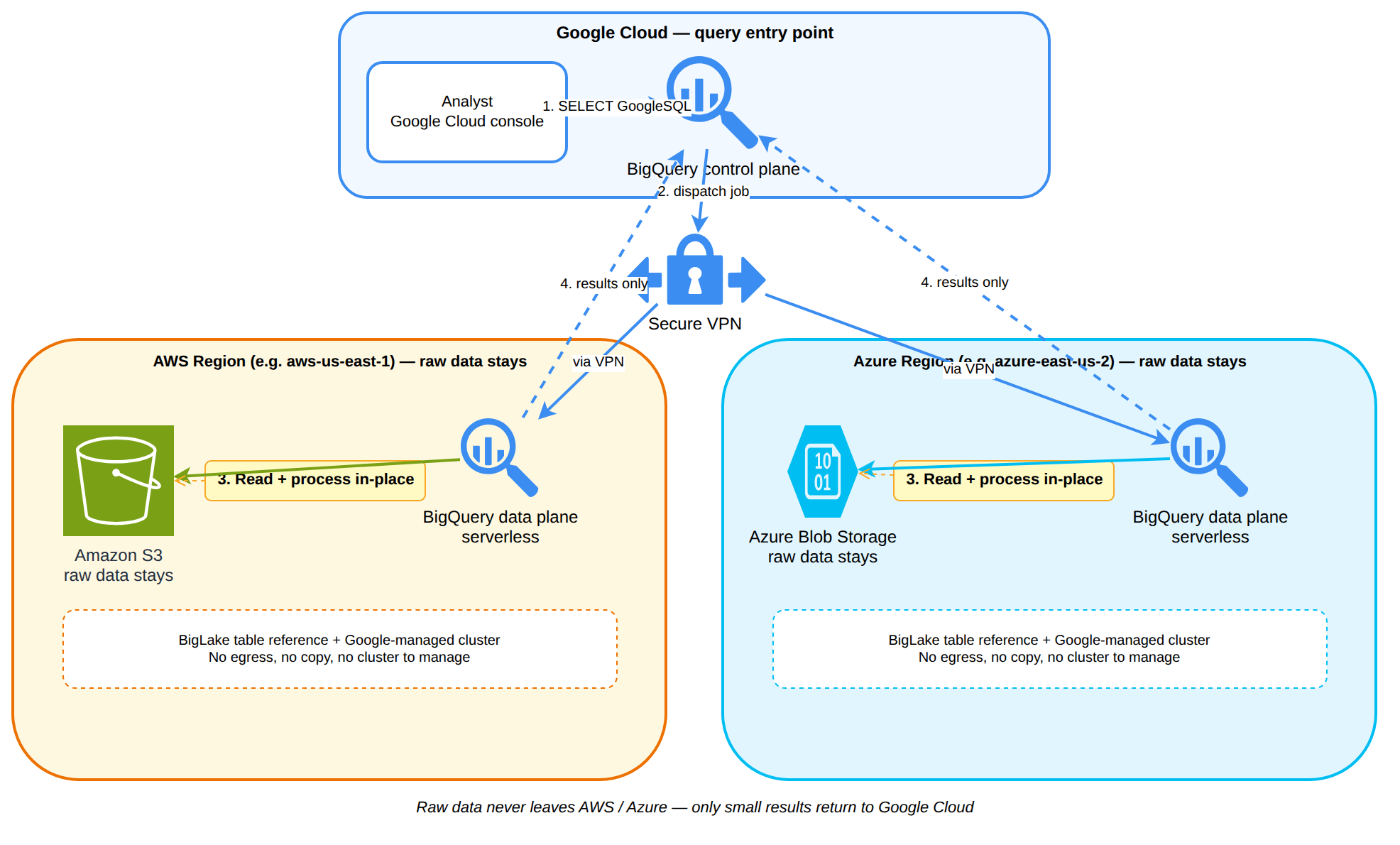
Key advantages and capabilities
- Unified management interface: Data teams write standard GoogleSQL queries from a single interface in their existing Google Cloud projects.
- Faster time to insights: Queries execute in the exact same cloud region where the data sits, eliminating the latency of cross-cloud data replication.
- Simplified billing: Customers incur no additional compute charges on their AWS or Azure bills for analytics processing, paying only through the standard BigQuery pricing model.
- Granular access control: Integrates with BigLake to enforce fine-grained row-level and column-level security through access delegation.
Why this is optimal
Compared to traditional extract, transform, and load (ETL) pipelines that physically duplicate petabytes of data across clouds, in-place query execution breaks down data silos immediately while minimizing both networking costs and administrative overhead.
Try 10 interactive questions like this one, free
Answer them yourself and get your score the moment you finish. No account needed.
Full access includes
- 3,070 practice questions across all 6 exam domains
- Every answer explained: why it is right, and why the others are not
- Scout, an AI tutor that answers your follow-up questions
- Readiness tracking by domain, so you know when to book the exam
Related free sample questions
Keep the momentum going with these hand-picked practice scenarios
FundamentalCloud Digital Leader
BigQuery, BigQuery ML, and Looker
Describe the transformation cloud and how it accelerates an organization’s digital transformation through app and infrastructure modernization, data democratization, people connections, and trusted transactions.
FundamentalCloud Digital Leader
API Specification Components
Define application programming interface (API).
FundamentalCloud Digital Leader
Cloud-First Hybrid Architecture with Apigee
Identify when private, hybrid, or multicloud infrastructures best apply to different business use cases.
FundamentalCloud Digital Leader
Data Lake vs Data Warehouse
Differentiate between basic data management concepts, in particular: databases, data warehouses, and data lakes.
FundamentalCloud Digital Leader
Cloud Billing Budgets vs Resource Quotas
Discuss how Google Cloud supports an organization's financial governance and ability to control their cloud costs.
FundamentalGenerative AI Leader
Lightweight vs Flagship Model Tiers
Models
Last updated