Fundamental
Prepare and test your skills
Fundamental
Prepare and test your skills
Filling Zero-Sales Gaps in Daily Forecasts
Free sample question, answered and explained below. The Associate Data Practitioner practice bank has 1,132 more like it. Try 10 free: instant score, no account.
A data practitioner is evaluating the completeness of a daily store sales table in Google Cloud BigQuery before building an inventory demand forecasting model. During the data assessment, the practitioner observes that several calendar dates are entirely missing from the time-series sequence because the retail store records no transactions on days with zero sales.
What impact do these missing rows have on downstream forecasting, and how should the practitioner resolve the gap?
Explanations
The missing rows are automatically generated and imputed using linear interpolation during training; the practitioner should leave the gaps in the table without any modification.
The missing rows are automatically generated and imputed using linear interpolation during training; the practitioner should leave the gaps in the table without any modification.
What Automatic Null Imputation Does
Machine learning platforms and database engines often include built-in mechanisms to impute individual null or missing attributes within existing rows (such as imputing missing feature columns using median values, surrounding context, or learned embeddings).
Why It Doesn't Meet the Requirement
- Conflates missing attributes with missing rows (✗): While null feature values inside an existing record may be automatically imputed or embedded, forecasting services do not synthesize missing row records across calendar dates. If a row for Tuesday does not exist between Monday and Wednesday, the pipeline processes Monday and Wednesday as consecutive observations.
- Distorts time perception (✗): When a model treats disconnected days as consecutive steps, seasonal metrics (such as day-of-week demand) become completely unaligned.
- Passive approaches harm quality (✗): Leaving data gaps unaddressed directly decreases model accuracy because the machine learning algorithms are unable to deduce that an absent row represents zero customer demand.
Key Characteristics and Limitations
- Tabular algorithms operate on the rows explicitly provided in the training table.
- Unhandled gaps alter the time frequency, causing moving-average and auto-regressive calculations to span inconsistent time horizons.
- Linear interpolation between non-zero days would erroneously invent sales volume for days when zero sales occurred.
This Answer Would Be Correct If
The dataset already contained explicit rows for every calendar date, but certain numerical feature columns (such as missing temperature or foot-traffic sensor readings) contained null values that could be imputed from adjacent timestamps.
The missing rows create training-serving skew because BigQuery stores gaps as whitespace strings; the practitioner should fill the gaps using Last Observation Carried Forward (LOCF).
The missing rows create training-serving skew because BigQuery stores gaps as whitespace strings; the practitioner should fill the gaps using Last Observation Carried Forward (LOCF).
What LOCF and Training-Serving Skew Are
Last Observation Carried Forward (LOCF) is an imputation technique used in time-series analysis where a missing data point is filled using the most recently observed valid value. Training-serving skew refers to an architectural discrepancy where the input features provided during model training differ structurally or statistically from the features provided at inference serving time.
Why It Doesn't Meet the Requirement
- Inappropriate imputation technique (✗): LOCF copies the previous observation forward. If a store sells 150 jackets on Sunday and is closed on Monday, LOCF would incorrectly impute 150 jacket sales for Monday, severely misrepresenting reality.
- Misunderstands missing rows (✗): Gaps in a table are omitted rows, not whitespace string characters (
" "). Furthermore, empty strings and nulls represent missing cell attributes, whereas omitted timestamps indicate absent records. - Inflates demand forecasts: Imputing non-zero values into periods with zero sales causes inventory planning models to order excess stock for typically quiet days.
Key Characteristics and Limitations of LOCF
- LOCF is suitable for continuous state metrics (such as unit pricing, exchange rates, or warehouse thermostat temperatures) that persist until updated.
- LOCF should never be applied to discrete transactional counts or event flows where absence indicates zero activity.
- Time series gap-filling methods in BigQuery include
LOCF,Linear, and constant values (NULL/zero), but the choice must align with the business context of the missing metric.
This Answer Would Be Correct If
The practitioner were filling gaps in a slow-changing state dimension—such as carrying forward the current retail price or product catalog status across days where no price update was published.
The missing rows introduce data leakage into the training split; the practitioner should delete the entire historical time series for any store location that contains date gaps.
The missing rows introduce data leakage into the training split; the practitioner should delete the entire historical time series for any store location that contains date gaps.
What Data Leakage Is
Data leakage occurs when a machine learning model is trained using features that inadvertently contain information about the target label that would not be available when the model is deployed to make real-time inferences in production. A common example is using future customer billing records to predict whether a customer will cancel their subscription this month.
Why It Doesn't Meet the Requirement
- Incorrect problem identification (✗): Missing rows represent an issue of data incompleteness, not data leakage. An omitted calendar day does not leak future ground-truth target information into the model's feature set.
- Destructive remediation (✗): Deleting entire store time series because of intermittent inactive dates discards valuable historical data, diminishes training sample size, and creates survivorship bias.
- Misunderstands retail data patterns: Zero-sales days are normal business occurrences during holidays, store closures, or slow retail seasons, not fraudulent or compromised records that require full dataset purging.
Key Characteristics and Limitations of Handling Leakage
- Data leakage is resolved by removing predictive target-correlated features or adjusting temporal training-validation-test splits.
- Purging entire store records severely limits the model's ability to generalize across diverse store profiles.
- Deleting data fails to address the underlying root cause of point-of-sale systems not emitting zero-event records.
This Answer Would Be Correct If
The scenario described an input feature containing future promotion schedules or downstream transaction confirmations that are only generated after a purchase is finalized, requiring feature exclusion to avoid artificial high performance during evaluation.
The missing rows degrade forecasting model quality because missing time steps are not automatically imputed; the practitioner should insert rows for the missing dates with sales explicitly set to 0.
The missing rows degrade forecasting model quality because missing time steps are not automatically imputed; the practitioner should insert rows for the missing dates with sales explicitly set to 0.
What Data Completeness and Missing Rows Represent
Data completeness is a fundamental pillar of data quality that assesses whether all required observations and time steps are present in a dataset. In time-series forecasting, data completeness requires an unbroken sequence of chronological intervals (such as daily, hourly, or weekly timestamps). A missing row occurs when an entire timestamp observation is omitted from the dataset rather than being recorded with a value of zero.
How It Meets the Requirements
- Identifies impact on model quality (✓): Automated machine learning and forecasting algorithms require regular temporal intervals to understand seasonality, trend patterns, and cycles. Although missing rows are technically permitted into ingestion pipelines, forecasting engines do not automatically impute missing rows; failing to supply them leads to distorted time signals and degraded forecast accuracy.
- Applies the correct imputation technique (✓): In transactional retail systems, an absent date signifies zero customer purchases rather than an unknown or missing quantity. To ensure data fitness, the practitioner must perform gap filling by explicitly generating records for the missing dates and setting the numeric sales target to
0. - Prevents analytical bias (✓): If days with zero sales are omitted, downstream models interpret the sales history as having artificially elevated baseline demand, resulting in overstocked inventory and inaccurate forecasts.
Gap Filling Zero-Sales Days for Forecasting
Timeline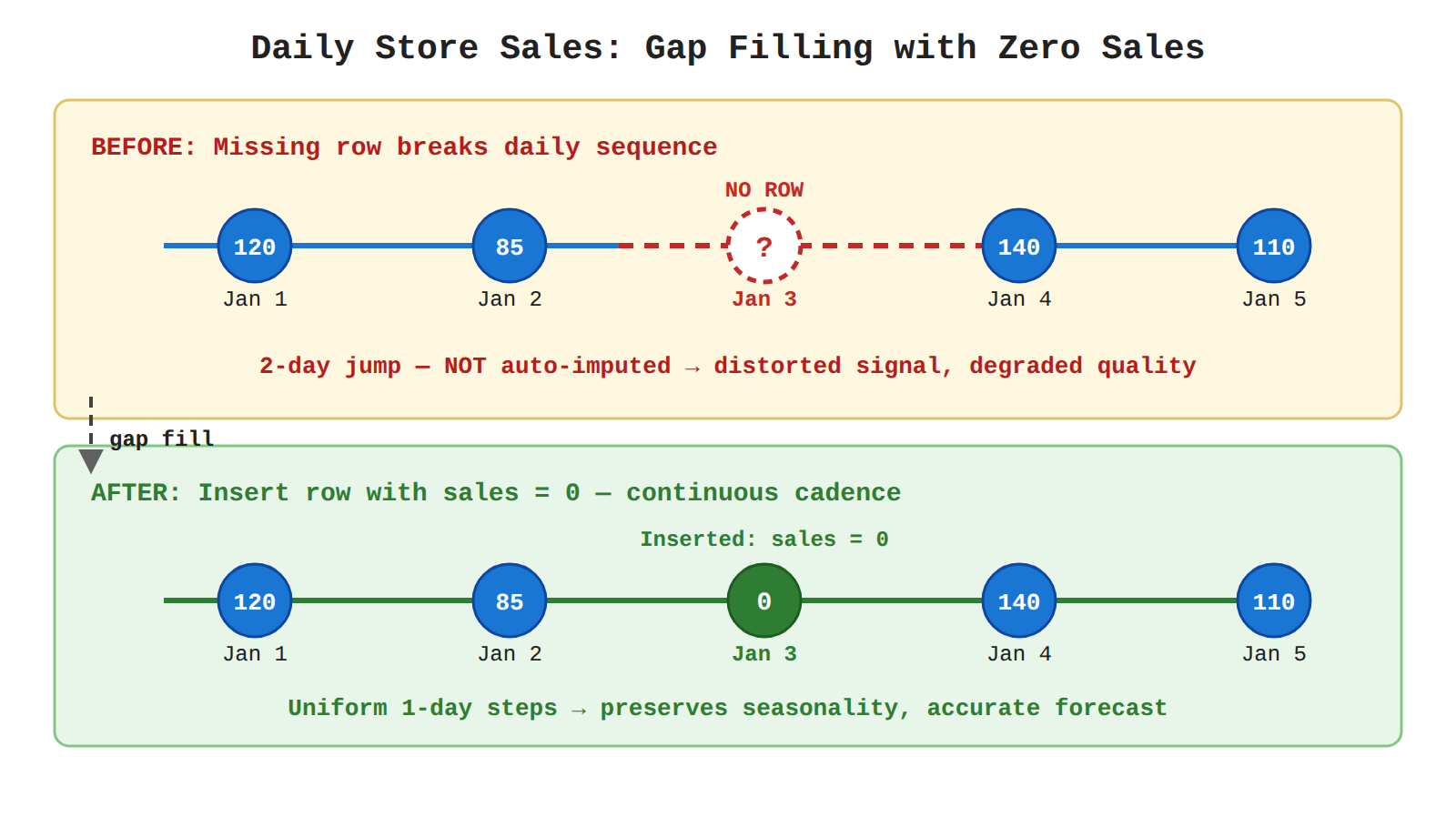
Key Advantages of Explicit Imputation
- Preserves temporal cadence: Ensures that consecutive rows reflect uniform calendar intervals, enabling accurate lag and moving-average calculations.
- Reflects operational reality: Explicitly represents zero consumer demand rather than leaving the model to treat absent dates as unobserved data.
- Eliminates artificial inflation: Prevents models from overestimating daily revenue and inventory turnover.
- Improves model convergence: Provides clear lower bounds for regression and forecasting loss functions.
Why This Is Optimal
Omitting dates with zero sales skews statistical distributions. By inserting missing dates and explicitly assigning a sales quantity of 0, the data practitioner restores complete temporal coverage and provides downstream models with an accurate reflection of historical business reality.
Try 10 interactive questions like this one, free
Answer them yourself and get your score the moment you finish. No account needed.
Full access includes
- 1,132 practice questions across all 4 exam domains
- Every answer explained: why it is right, and why the others are not
- Scout, an AI tutor that answers your follow-up questions
- Readiness tracking by domain, so you know when to book the exam
Related questions
Keep the momentum going with these hand-picked practice scenarios
FundamentalAssociate Data Practitioner
Dataform rowConditions Assertions
Assess data quality
FundamentalAssociate Data Practitioner
BigQuery SQL Data Validation
Assess data quality
FundamentalAssociate Data Practitioner
BigQuery ML ML.PREDICT
Perform inference using BigQuery ML models
FundamentalAssociate Data Practitioner
Firestore for Semi-Structured Data, Cloud Storage for Unstructured
Classify use cases into having structured, unstructured, or semi-structured data requirements
FundamentalAssociate Data Practitioner
Dataflow Diagnostics Tab
Monitor Dataflow pipeline progress using the Dataflow job UI
AdvancedProfessional Cloud DevOps Engineer
Gemini Cloud Assist Context-Rich Prompting
Using Gemini Cloud Assist for AI-powered log analysis
Last updated