Fundamental
Prepare and test your skills
Fundamental
Prepare and test your skills
Reassigning the Default Alias Before Deletion
Free sample question, answered and explained below. The Associate Data Practitioner practice bank has 1,156 more like it. Try 10 free: instant score, no account.
A data engineering team manages multiple iterations of a machine learning model in Google Cloud's Model Registry. They are cleaning up obsolete assets and need to delete an older model version that is currently designated with the default alias.
What must the team do in Model Registry to successfully delete this model version?
Explanations
Manually clear all associated model evaluations and metadata to force the registry to release the default alias lock.
Manually clear all associated model evaluations and metadata to force the registry to release the default alias lock.
What Model Evaluations and Metadata Are
Model evaluations and metadata in Model Registry store key quantitative performance metrics (such as accuracy, ROC-AUC, or log loss), training configurations, and input/output schema definitions. These artifacts provide traceability and governance across different iterations.
Why It Doesn't Meet the Requirement
- Misunderstands Alias Mechanism (✗): The
defaultalias is not locked by metadata or evaluation artifacts. It is an explicit pointer managed at the model version level. - Automatic Evaluation Cleanup (✗): When a model version is deleted, all associated model evaluations are automatically removed by Google Cloud. Manually deleting them is unnecessary and does not release the default alias.
Key Characteristics
- Coupled Lifecycle: Evaluations are inherently bound to the specific model version they benchmark.
- Read-Only Provenance: Historical evaluations serve as compliance records and do not act as concurrency locks on aliases.
This Answer Would Be Correct If:
The team needed to update or remove corrupted evaluation metrics without modifying or deleting the underlying model binary.
Delete the entire parent model resource, which automatically purges all versions and re-registers the remaining versions under a new identifier.
Delete the entire parent model resource, which automatically purges all versions and re-registers the remaining versions under a new identifier.
What Deleting the Parent Model Resource Does
Deleting the parent model resource removes the entire model entity from the Model Registry. This action executes a cascading deletion that permanently deletes all underlying model versions, associated metadata, and evaluation records across the entire lifecycle of that model family.
Why It Doesn't Meet the Requirement
- Destructive to All Iterations (✗): The scenario specifically requires deleting a single obsolete model version while preserving other active versions. Deleting the parent model deletes all versions indiscriminately.
- No Automatic Re-registration (✗): Deleting the parent resource does not re-register or preserve the other versions under a new identifier; the entire asset is deleted.
Key Limitations
- Complete Data Loss: Removes all historical performance metrics, lineage, and version history.
- Pipeline Breakdown: Any endpoint or pipeline depending on other versions of that model family will fail.
- Irreversible Operation: Cannot be scoped down to target only the obsolete version.
This Answer Would Be Correct If:
The team wanted to completely decommission a deprecated project and permanently delete all versions and metadata belonging to the model family.
Execute an unregister command to demote the version to an unversioned draft state before deletion.
Execute an unregister command to demote the version to an unversioned draft state before deletion.
What Unregistering or Draft States Represent
In some software package managers, assets can exist in an unversioned or draft state. However, in Google Cloud's Model Registry, every model asset registered is strictly immutable and versioned (e.g., version 1, version 2).
Why It Doesn't Meet the Requirement
- Non-Existent Concept in Model Registry (✗): Model Registry does not have an "unversioned draft state" or an "unregister to draft" command. Models uploaded to the registry must exist as concrete versions.
- Does Not Resolve Default Alias Conflict (✗): Even if versions could be unlinked, an active model family in the registry requires valid alias routing if downstream consumers query the default alias.
Key Characteristics
- Immutable Version Numbers: Once created, numeric version IDs remain constant.
- Direct Deletion via CLI/Console: Model versions are directly deleted using standard API/CLI commands (
gcloud ai models delete-version) or the console interface rather than lifecycle state demotions.
This Answer Would Be Correct If:
Google Cloud Model Registry supported a staging workspace where models could be modified in-place as non-versioned drafts before formal registration.
Assign the default alias to another model version prior to or during the deletion confirmation process.
Assign the default alias to another model version prior to or during the deletion confirmation process.
What Model Registry Versioning and Aliases Are
In Google Cloud's Model Registry, models are managed as versioned assets under a unified model resource. Each version represents a specific iteration of trained model artifacts, evaluation metrics, and metadata. To simplify model tracking, promotion, and downstream deployment, version aliases (such as default or custom labels like production and staging) point to specific numeric versions. The default alias identifies the primary version of the model used whenever a specific version ID is not explicitly provided in API calls or deployment pipelines.
How It Meets the Requirements
- Protects Active Workflows (✓): The Model Registry enforces safety guardrails preventing the direct deletion of a version holding the active
defaultalias, ensuring downstream processes referencing the default model do not encounter missing resources. - Enables Seamless Reassignment (✓): When initiating deletion of the default version through the Google Cloud console or API/SDK, the user is required to select another existing model version to inherit the
defaultalias, ensuring continuous model governance and integrity. - Safe Asset Lifecycle Management (✓): Once the default alias is safely re-pointed to another designated version, the obsolete version and its associated evaluation metrics can be safely purged.
Reassigning Default Alias to Delete a Version
Process Flow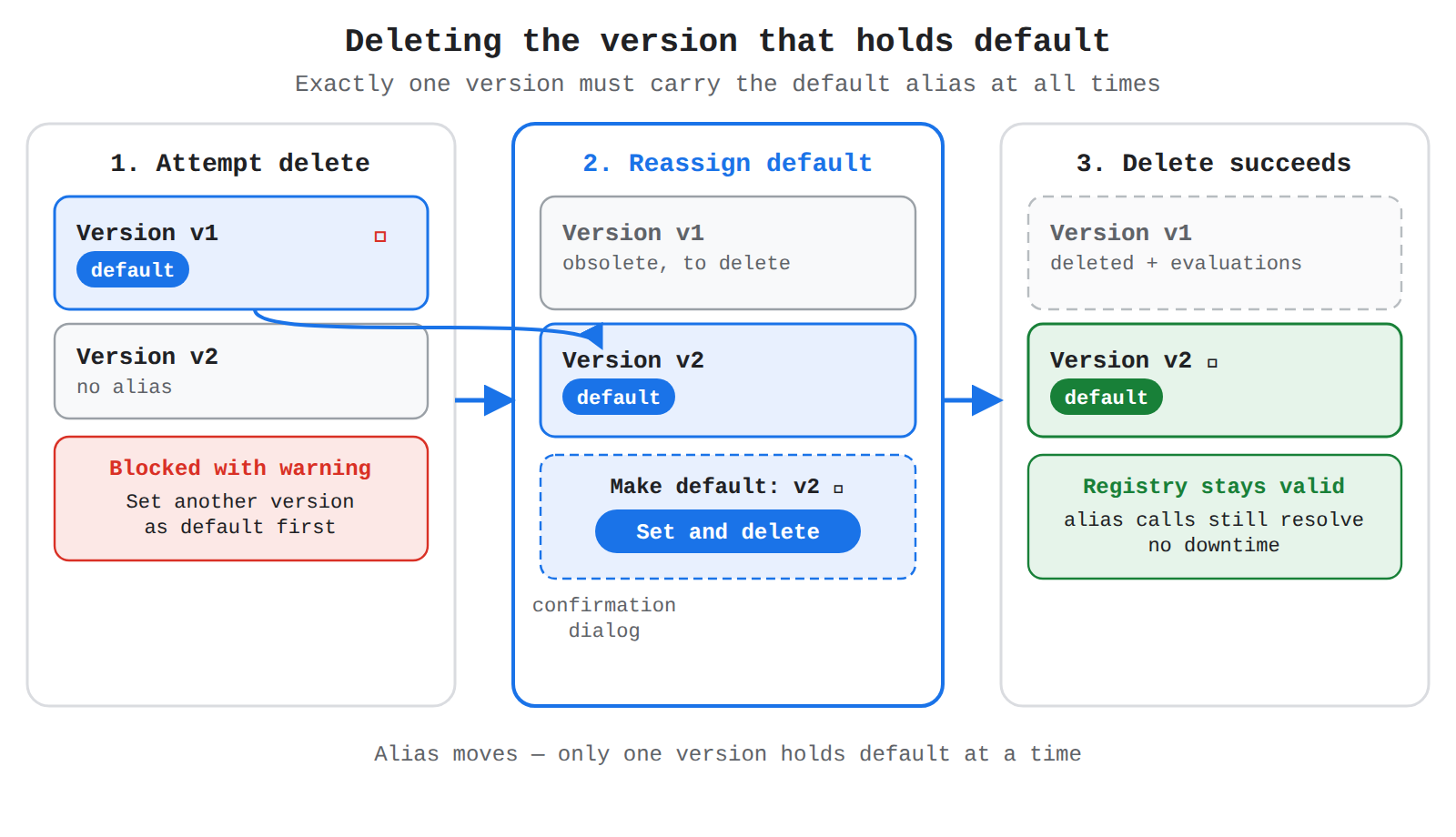
Key Advantages and Governance Best Practices
- Lifecycle Identifiers: Aliases abstract mutable model states from immutable version numbers, allowing seamless promotion without code changes.
- Accidental Deletion Prevention: Built-in safeguards protect critical operational versions from unintended deletion.
- Clean Version Lineage: Deleting obsolete iterations keeps the registry organized while retaining required evaluation histories for active models.
- Unified Metadata Tracking: Ensures that active models always retain proper provenance, schemas, and performance evaluations.
Why This Is Optimal
Reassigning the default alias ensures zero operational downtime for client services querying the model without version qualifiers. It is the established governance procedure in Google Cloud Model Registry to maintain asset consistency.
Try 10 interactive questions like this one, free
Answer them yourself and get your score the moment you finish. No account needed.
Full access includes
- 1,156 practice questions across all 4 exam domains
- Every answer explained: why it is right, and why the others are not
- Scout, an AI tutor that answers your follow-up questions
- Readiness tracking by domain, so you know when to book the exam
Related questions
Keep the momentum going with these hand-picked practice scenarios
FundamentalAssociate Data Practitioner
Model Registry and Vertex ML Metadata Lineage
Organize models in Model Registry
FundamentalAssociate Data Practitioner
Model Registry Aliases
Organize models in Model Registry
FundamentalAssociate Data Practitioner
Dataform for BigQuery ELT
Select a data transformation tool (e.g., Dataproc, Dataflow, Cloud Data Fusion, Cloud Composer, Dataform) based on business requirements
FundamentalAssociate Data Practitioner
Cloud Storage Object Lifecycle Management
Configure rules to delete objects after a specified period to automatically remove unnecessary data and reduce storage expenses (e.g., BigQuery, Cloud Storage)
FundamentalAssociate Data Practitioner
BigQuery Data Transfer Service Supported Formats
Distinguish the format of the data (e.g., CSV, JSON, Apache Parquet, Apache Avro, structured database tables)
AdvancedProfessional Cloud DevOps Engineer
Artifact Analysis Provider-Customer Metadata Model
Artifact Registry configuration
Last updated