Fundamental
Prepare and test your skills
Fundamental
Prepare and test your skills
Automatic 30-Day Deletion with GCS Lifecycle Management
Free sample question, answered and explained below. The Associate Data Practitioner practice bank has 1,156 more like it. Try 10 free: instant score, no account.
A data engineering team at a retail organization uploads daily transaction log files into a Google Cloud Storage bucket. To minimize storage costs and comply with internal data retention guidelines, the team needs to automatically delete log files once they are 30 days old.
Which method should the team use to configure and manage automated object deletion on the Cloud Storage bucket?
Explanations
Configure Datastore TTL policies on an entity kind to periodically scan Cloud Storage metadata and delete old files.
Configure Datastore TTL policies on an entity kind to periodically scan Cloud Storage metadata and delete old files.
What Datastore TTL is
Datastore Time-to-Live (TTL) is a feature for Firestore in Datastore mode databases that automatically purges entities from a specified kind when a timestamp property reaches expiration.
Why it doesn't meet the requirement
- Database scope only (✗): Datastore TTL works exclusively on Datastore entities and kinds across database namespaces. It does not interface with or scan Cloud Storage buckets.
- Cannot delete storage objects (✗): Setting a TTL property in Datastore has no effect on external files or log archives stored in Cloud Storage.
Key characteristics and limitations
- Kind-level application: Applies to all entities of a specified kind across all namespaces within the Datastore database.
- Requires Date and time type: The property designated for the TTL policy must use the
Date and timedata type. - Background asynchronous cleanup: Deletions are treated with lower priority to prevent interference with live database read and write workloads.
This answer would be correct if
The scenario required automatically removing expired transactional entities or temporary state entries from a Google Cloud Datastore database.
Configure an Object Lifecycle Management rule on the bucket with a Delete action based on the Age condition, and update or clear the bucket's lifecycle configuration if policies change.
Configure an Object Lifecycle Management rule on the bucket with a Delete action based on the Age condition, and update or clear the bucket's lifecycle configuration if policies change.
What Cloud Storage Object Lifecycle Management is
Cloud Storage Object Lifecycle Management allows administrators and data engineers to define automated rules that apply actions to objects stored within a bucket when specified conditions are met. These rules run automatically in the background without requiring custom code or scheduled jobs.
How it meets the requirements
- Automated deletion (✓): Setting an action type of
Deletecombined with anAgecondition of 30 days ensures that all objects reaching 30 days since creation are automatically scheduled for permanent deletion. - Storage cost optimization (✓): Automatically purging old or unnecessary log data prevents unbounded storage growth and reduces ongoing Google Cloud storage expenses.
- Manageability and updates (✓): If retention policies change or automated deletion needs to be suspended, the bucket's lifecycle configuration can be updated, patched, or reset to remove all existing rules.
30-Day Auto-Delete Timeline for Cloud Storage
Timeline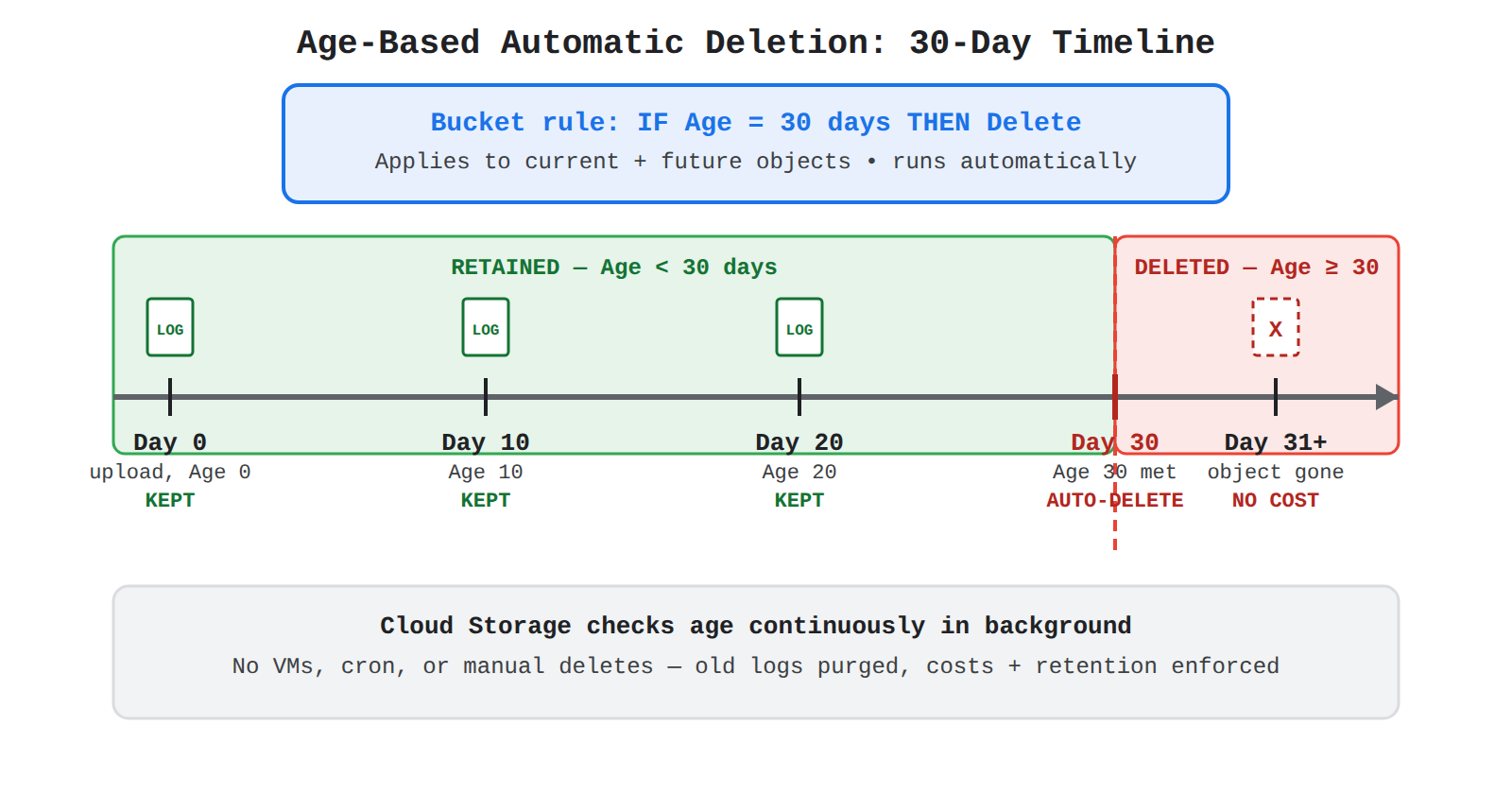
Key advantages and capabilities
- No server management: Operates completely serverless within Cloud Storage without needing Compute Engine instances or cron schedulers.
- Granular condition matching: Supports conditions such as
Age,CreatedBefore,IsLive,MatchesStorageClass, andNumberOfNewerVersions. - Tier transition and deletion: Can transition objects to colder storage classes (Nearline, Coldline, Archive) before eventual deletion.
- Lifecycle lifecycle reset: Lifecycle rules can be inspected, updated, or removed entirely via the Google Cloud console, the Google Cloud CLI (
gcloud storage), or client library APIs by patching the bucket metadata.
Why this is optimal
Native Object Lifecycle Management is the Google Cloud recommended mechanism for managing data retention and automated cleanup on Cloud Storage buckets. It eliminates the operational overhead and failure risks associated with maintaining custom deletion scripts.
Create a Firestore Time-to-Live (TTL) policy on a collection group designating a timestamp field to manage log expiration.
Create a Firestore Time-to-Live (TTL) policy on a collection group designating a timestamp field to manage log expiration.
What Firestore TTL is
Firestore Time-to-Live (TTL) is a database retention mechanism that automatically removes obsolete documents from Firestore collections or collection groups based on a designated timestamp field of type Date and time.
Why it doesn't meet the requirement
- Wrong storage system (✗): Firestore TTL applies strictly to documents stored in Google Cloud Firestore NoSQL databases, not to files or binary objects stored in Cloud Storage buckets.
- No bucket integration (✗): Firestore TTL cannot inspect, manage, or delete blobs, objects, or directories located inside Cloud Storage.
Key characteristics and limitations
- Collection-level scope: TTL policies are configured per collection group on a single timestamp property.
- Non-instantaneous deletion: Documents are typically deleted within 24 hours after their expiration timestamp has passed.
- Database operation: TTL deletions generate standard document delete operations and trigger database-level snapshot listeners and triggers.
This answer would be correct if
The scenario required automatically removing stale database records or user session documents from a Firestore NoSQL collection based on a specified expiration date field.
Additional context
While Firestore TTL and Cloud Storage Lifecycle Management both solve data retention needs, each tool is purpose-built for its respective storage engine (NoSQL documents vs. object storage).
Apply a Backup and Disaster Recovery image expiration policy with enforced retention to force object deletion.
Apply a Backup and Disaster Recovery image expiration policy with enforced retention to force object deletion.
What Backup and DR image expiration is
Google Cloud Backup and Disaster Recovery (Backup and DR) manages snapshot images, backups, and recovery point objectives (RPOs) across protected enterprise workloads and virtual machines.
Why it doesn't meet the requirement
- Target mismatch (✗): Backup and DR policies manage backup appliance images and application recovery point data, not standard object lifecycle rules on general-purpose Cloud Storage buckets.
- Enforced retention prevents deletion (✗): Enforced retention locks images so they cannot be expired or deleted before a specified immutability period ends, which directly contradicts setting up immediate automated deletion workflows.
Key characteristics and limitations
- Image-specific management: Designed to manage lifecycle and retention for backup images generated from databases, file systems, and VMs.
- Enforced retention constraints: Images with enforced retention cannot be deleted until their immutability period passes.
- Incompatible with standard object buckets: General-purpose Cloud Storage buckets do not use the Backup and DR App Manager interface for regular object lifecycle rules.
This answer would be correct if
The goal was to govern retention, expiration schedules, and immutability locks on application backup recovery images within the Backup and DR service.
Try 10 interactive questions like this one, free
Answer them yourself and get your score the moment you finish. No account needed.
Full access includes
- 1,156 practice questions across all 4 exam domains
- Every answer explained: why it is right, and why the others are not
- Scout, an AI tutor that answers your follow-up questions
- Readiness tracking by domain, so you know when to book the exam
Related questions
Keep the momentum going with these hand-picked practice scenarios
FundamentalAssociate Data Practitioner
Cloud Storage Object Lifecycle Management
Configure rules to delete objects after a specified period to automatically remove unnecessary data and reduce storage expenses (e.g., BigQuery, Cloud Storage)
FundamentalAssociate Data Practitioner
BigQuery Partition Expiration
Configure rules to delete objects after a specified period to automatically remove unnecessary data and reduce storage expenses (e.g., BigQuery, Cloud Storage)
FundamentalAssociate Data Practitioner
BigQuery Generative AI Functions
Use pretrained Google large language models (LLMs) using remote connection in BigQuery
FundamentalAssociate Data Practitioner
Encryption In Transit vs Encryption At Rest
Identify the difference between encryption in transit and encryption at rest
FundamentalAssociate Data Practitioner
Cloud KMS Asymmetric Envelope Encryption
Understand the role of Cloud Key Management Service (Cloud KMS) to manage encryption keys
IntermediateProfessional Cloud Architect
Cloud Audit Logs Types and Private Logs Viewer
Audits (including logs)
Last updated