Fundamental
Prepare and test your skills
Fundamental
Prepare and test your skills
Dual-Region Buckets for Regional Outage Protection
Free sample question, answered and explained below. The Associate Data Practitioner practice bank has 1,156 more like it. Try 10 free: instant score, no account.
An analytics team stores critical data backups and reporting files in Google Cloud Storage. The team needs to choose a bucket location type that satisfies the following requirements:
- The data must remain accessible even if an entire Google Cloud region experiences a complete disaster or outage.
- Redundancy must be maintained across two specific, predefined geographic regions within the same continent to ensure predictable network performance for localized compute jobs.
- The solution should avoid the unnecessary data transfer costs and broader dispersion of data associated with broad multi-region bucket configurations.
Which Cloud Storage location type should the team select?
Explanations
Region (Single-region)
Region (Single-region)
What Single-region storage is:
A single-region location in Cloud Storage places object data within a specific geographic location (such as us-central1 or europe-west1), distributing the data across multiple availability zones within that single region.
Why it doesn't meet the requirement:
- No regional disaster recovery (✗): Single-region buckets do not replicate data outside the designated region. If a catastrophic disaster or severe regional outage occurs, data in a single region may become temporarily or permanently inaccessible until the region is restored.
- Lack of cross-region redundancy (✗): While single-region buckets provide zone-redundancy within that region, they cannot satisfy the requirement for automatic geo-redundancy across two separate regions.
Key characteristics/limitations:
- Lowest storage price: Offers the most economical price point per gigabyte for data storage compared to dual-regions and multi-regions.
- Lowest latency for local compute: Provides optimal read/write latency when compute engines (like Compute Engine VMs or Dataproc clusters) reside in the exact same region.
- Lower availability SLA: Standard single-region storage provides a 99.9% monthly uptime SLA, which is lower than the 99.95% SLA of dual-region and multi-region locations.
This answer would be correct if:
The scenario stated that all data consumers and compute workloads were hosted in a single Google Cloud region, budget minimization was the primary driver, and regional disaster recovery was not required.
Additional context:
Single-region storage is ideal for batch ETL staging and temporary datasets where compute jobs run locally and data can easily be re-generated if a regional incident occurs.
Zonal (Zone-specific storage)
Zonal (Zone-specific storage)
What Zonal storage is:
In Google Cloud, individual zones represent isolated deployment areas within a single region (such as us-central1-a). While Cloud Storage does not offer a standalone zonal bucket type (Cloud Storage is regional or multi-regional by default), other storage services such as Compute Engine Persistent Disks offer zonal storage options.
Why it doesn't meet the requirement:
- Single point of failure (✗): Zonal storage is confined to one physical data center facility or cluster. Any event affecting that specific zone causes immediate downtime, failing both zone-level and region-level redundancy requirements.
- No geo-redundancy (✗): Zonal storage cannot provide automatic failover or data replication to a secondary region.
Key characteristics/limitations:
- Confined failure domain: Subject to outages from local power, networking, or hardware maintenance events within that single zone.
- Not a standard Cloud Storage bucket location: Cloud Storage natively replicates data across multiple zones even in its most basic Single-region tier.
- No cross-zone or cross-region SLAs: Zonal storage resources do not offer multi-zone or multi-region availability guarantees.
This answer would be correct if:
The question focused on attaching a standard Compute Engine persistent disk to a single virtual machine where sub-millisecond local IOPS performance was the only consideration and high availability was not required.
Additional context:
All Google Cloud Storage buckets—regardless of whether they are configured as Region, Dual-region, or Multi-region—are at least zone-redundant, meaning data is always stored across multiple independent zones within a region.
Dual-region
Dual-region
What Dual-region Cloud Storage is:
Dual-region storage is a Google Cloud Storage location type that automatically stores object data and metadata redundantly across two specific, separate geographic regions within the same continent (such as nam4 for us-central1 and us-east1, or a custom dual-region pair).
Dual-Region Bucket: NAM4 Paired Replication
System Architecture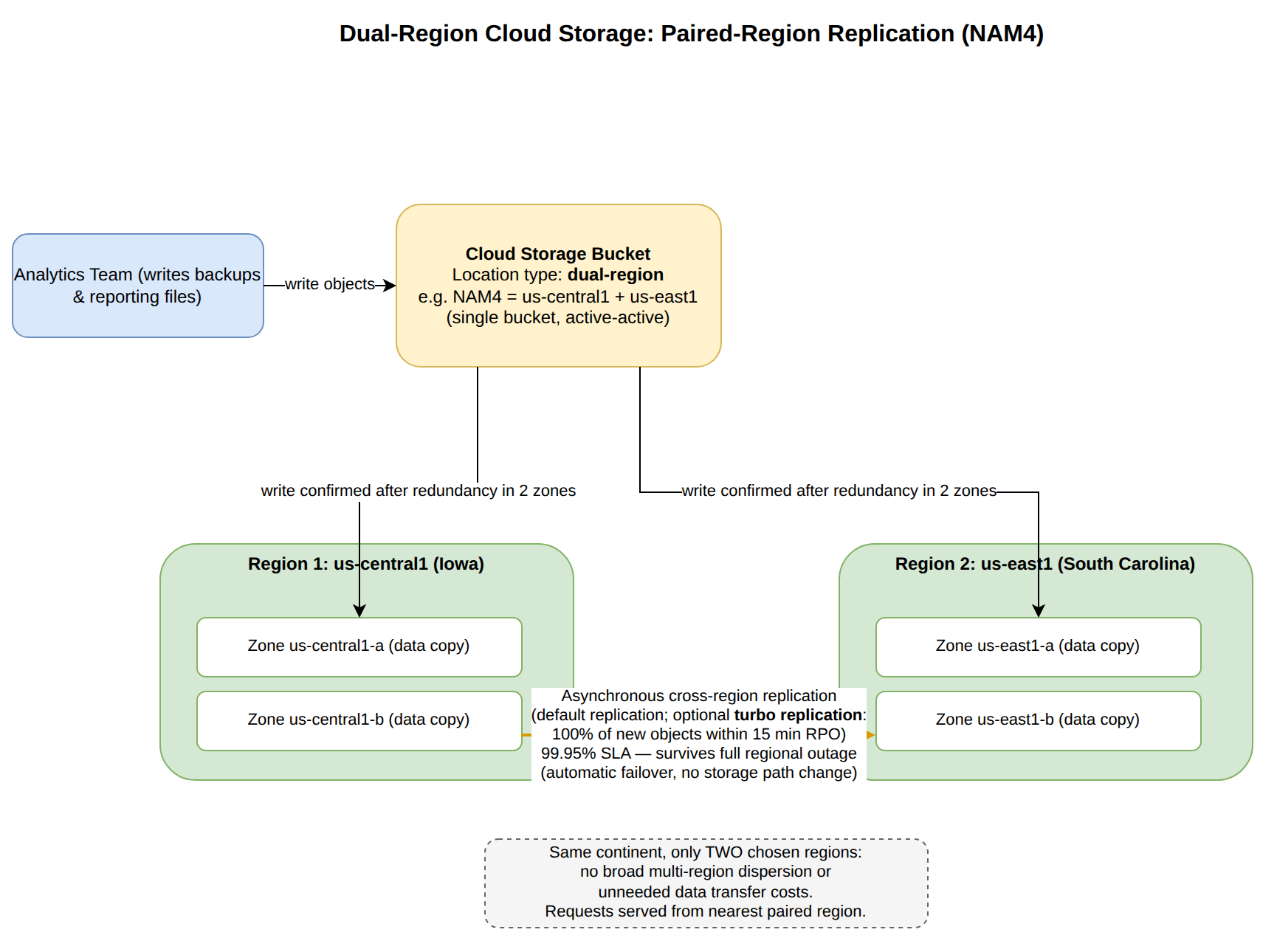
How it meets all requirements:
- Regional disaster recovery (✓): In the event of a full regional disaster or outage affecting one region, data remains immediately available from the secondary paired region without requiring manual intervention or DNS changes.
- Specific geographic pairing (✓): Unlike broader continent-wide multi-regions, dual-regions allow organizations to explicitly designate two specific target regions that align with their primary compute workloads.
- Optimized performance and predictable costs (✓): Dual-region provides low-latency data access to compute workloads running in either paired region and provides higher availability SLAs than single-region storage without dispersing data across unnecessary distant regions.
Key advantages/capabilities:
- Automatic cross-region replication: Objects written to a dual-region bucket are replicated asynchronously across both paired regions while maintaining strong global consistency for object metadata.
- High availability SLA: Provides a 99.95% monthly uptime SLA for Standard storage (higher than single-region's 99.9% SLA).
- Turbo replication support: Offers an optional feature to replicate 100% of newly written objects between the paired regions within a 15-minute window.
- Simplified disaster recovery architecture: Applications do not need to implement custom replication pipelines or manage separate failover buckets across regions.
Why this is optimal:
Dual-region storage delivers the exact balance needed: it provides true geo-redundancy and high availability against regional outages, restricts data residency and replication to two chosen regions, and avoids the broad geographic footprint and associated latency variability of large multi-regions.
Multi-region
Multi-region
What Multi-region storage is:
A multi-region location type stores object data and metadata redundantly across at least two large geographic areas spread across an entire continent (such as US, EU, or ASIA), spanning several individual Google Cloud regions.
Why it doesn't meet the requirement:
- Broad geographic dispersion (✗): Multi-region buckets automatically distribute and serve data across many regions within a continental boundary, preventing the team from restricting and optimizing data access to two specific, selected regional sites.
- Potential latency variability for localized pipelines (✗): Because requests may be served from any regional endpoint within the multi-region boundary, network latency is less predictable for tightly coupled compute jobs concentrated in two specific paired regions.
Key characteristics/limitations:
- Highest geographic availability: Designed for serving frequently accessed content (e.g., website assets, video streaming) to distributed end users across an entire continent.
- Automatic multi-datacenter redundancy: Offers a 99.95% monthly availability SLA with built-in resilience against regional failures.
- Higher storage cost: Storage pricing is comparable to dual-region, but data placement cannot be targeted to a strict two-region operational footprint.
This answer would be correct if:
The scenario required distributing public website media or analytics content to end users situated across the entire United States or Europe, where global or continental edge-caching and broad multi-regional availability are primary requirements.
Additional context:
While multi-regions deliver excellent disaster recovery, dual-regions were specifically introduced by Google Cloud to give organizations precise control over the exact two regions used for replication, data sovereignty, and compute proximity.
Try 10 interactive questions like this one, free
Answer them yourself and get your score the moment you finish. No account needed.
Full access includes
- 1,156 practice questions across all 4 exam domains
- Every answer explained: why it is right, and why the others are not
- Scout, an AI tutor that answers your follow-up questions
- Readiness tracking by domain, so you know when to book the exam
Related questions
Keep the momentum going with these hand-picked practice scenarios
FundamentalAssociate Data Practitioner
Cloud Storage Dual-Region
Distinguish between primary and secondary data storage location type (e.g., regions, dual-regions, multi-regions, zones) for data redundancy
FundamentalAssociate Data Practitioner
Zonal High Availability with Cross-Region Disaster Recovery
Distinguish between primary and secondary data storage location type (e.g., regions, dual-regions, multi-regions, zones) for data redundancy
FundamentalAssociate Data Practitioner
BigQuery ML.EVALUATE Model Evaluation
Perform inference using BigQuery ML models
FundamentalAssociate Data Practitioner
CMEK vs CSEK vs GMEK
Identify use cases for customer-managed encryption keys (CMEK), customer-supplied encryption keys (CSEK), and Google-managed encryption keys (GMEK)
FundamentalAssociate Data Practitioner
BigQuery Column Projection and Predicate Pushdown
Define and execute SQL queries in BigQuery to generate reports and extract key insights
IntermediateProfessional Cloud Architect
Warm Standby Disaster Recovery Pattern
Business continuity plan
Last updated