Fundamental
Prepare and test your skills

Fundamental
Prepare and test your skills
Ingesting Third-Party Metrics with Ops Agent
Free sample question with answers and detailed explanation below. The Associate Cloud Engineer practice bank has an additional 2,014 practice questions.Try 10 free realistic questions: instant score, no credit card, and no account required.
Your team is running a third-party application on Compute Engine Linux virtual machines (VMs). You have installed the Google Cloud Ops Agent on the instances and now need to collect application-specific telemetry and ingest it into Cloud Monitoring.
Which configuration and permission setup should you implement to enable third-party metric ingestion?
Explanations
Install the legacy Cloud Monitoring collectd agent, add plugins to /etc/stackdriver/collectd.conf, and grant the Pub/Sub Publisher role (roles/pubsub.publisher) to the VM's service account.
Install the legacy Cloud Monitoring collectd agent, add plugins to /etc/stackdriver/collectd.conf, and grant the Pub/Sub Publisher role (roles/pubsub.publisher) to the VM's service account.
What This Option Is and Does
This approach relies on the deprecated legacy Cloud Monitoring agent (collectd) and attempts to route metrics using Cloud Pub/Sub by assigning the Pub/Sub Publisher (roles/pubsub.publisher) role to the instance.
Why It Doesn't Meet the Requirement
- Deprecated Agent: The legacy
collectdagent is deprecated in favor of the unified Google Cloud Ops Agent, which supports modern telemetry standards like OpenTelemetry. - Incorrect Permission for Monitoring: The
roles/pubsub.publisherrole allows publishing messages to Pub/Sub topics, not writing metrics to Cloud Monitoring APIs (monitoring.googleapis.com). - Misaligned Architecture: Cloud Monitoring agent integrations ingest metrics directly via Monitoring APIs rather than staging data through Pub/Sub topics.
Key Characteristics and Limitations
- Legacy agents do not support the unified logging and metrics capabilities of the Ops Agent.
/etc/stackdriver/collectd.confis ignored by the Ops Agent.- Ingestion fails without the
roles/monitoring.metricWriterIAM permission.
This Answer Would Be Correct If
You were designing an asynchronous event-driven data streaming pipeline where VM applications publish raw event payloads directly to a Pub/Sub topic for downstream processing.
Define the third-party receiver and pipeline in /etc/google-cloud-ops-agent/config.yaml, restart the Ops Agent, and assign the Monitoring Metric Writer role (roles/monitoring.metricWriter) to the VM's service account.
Define the third-party receiver and pipeline in /etc/google-cloud-ops-agent/config.yaml, restart the Ops Agent, and assign the Monitoring Metric Writer role (roles/monitoring.metricWriter) to the VM's service account.
What the Ops Agent Configuration and IAM Setup Is
The Google Cloud Ops Agent is the primary agent for collecting logs and metrics from Compute Engine virtual machines. It combines logging (Fluent Bit) and metrics (OpenTelemetry Collector) subsystems into a unified service managed through a single configuration file (/etc/google-cloud-ops-agent/config.yaml on Linux).
How It Meets the Requirements
- Configures Third-Party Metrics: Third-party application integrations (such as Couchbase, Redis, or Apache) are configured by declaring application-specific receivers and linking them to metric pipelines inside
/etc/google-cloud-ops-agent/config.yaml. - Applies Configuration: Restarting the agent via system service managers (e.g.,
sudo systemctl restart google-cloud-ops-agent) loads the new configuration pipelines and starts metric scraping. - Ensures Secure Transmission: Ingesting metrics into Cloud Monitoring requires the VM's attached service account to have the Monitoring Metric Writer (
roles/monitoring.metricWriter) IAM role, granting permission to write time-series data tomonitoring.googleapis.com.
Ops Agent Third-Party Metric Ingestion Pipeline
System Architecture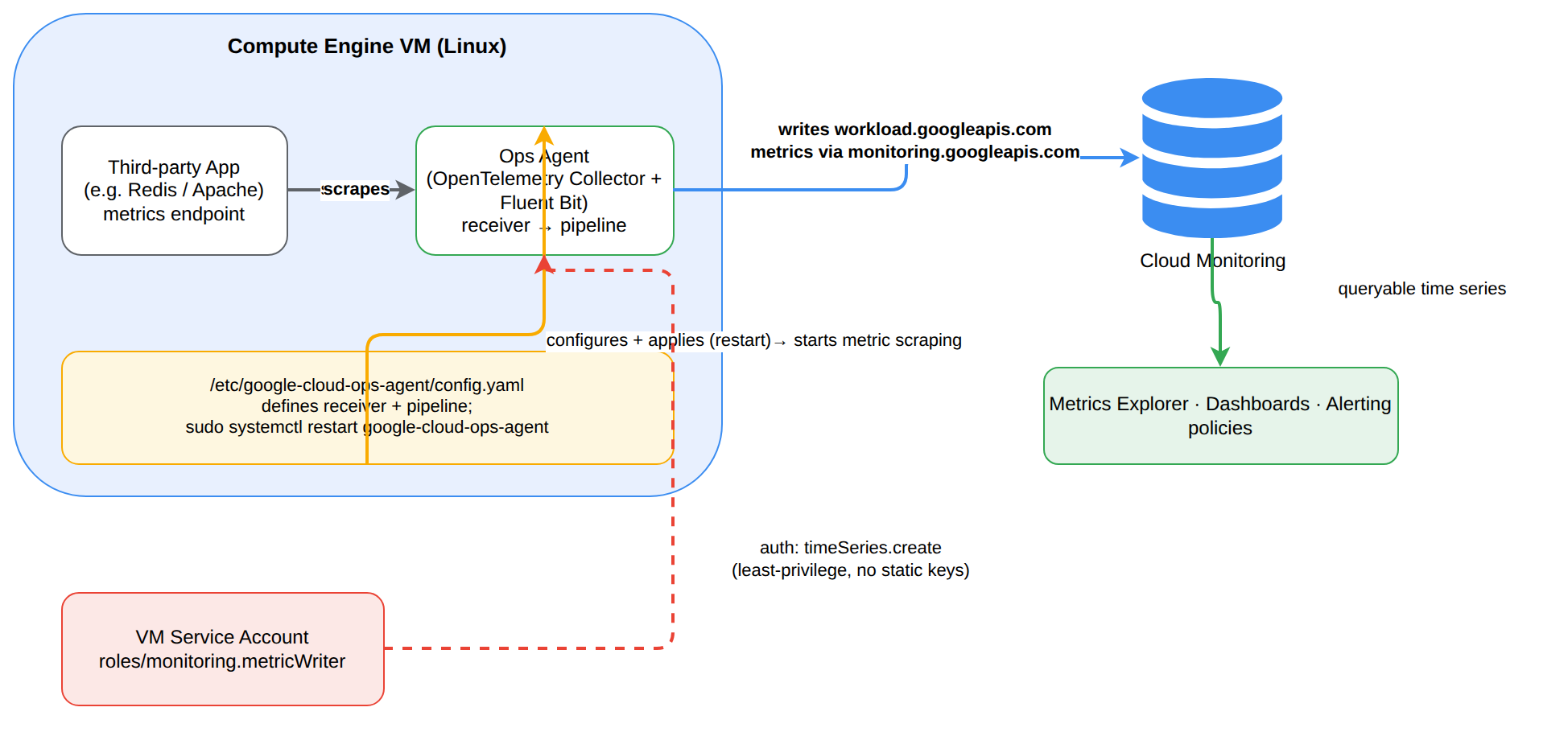
Key Advantages and Capabilities
- Unified Telemetry Collection: Handles both application metrics and system logging in a single lightweight process.
- Native Integration Support: Built-in support for numerous third-party databases, web servers, and open-source metrics receivers like Prometheus and OTLP.
- Least-Privilege Security: Using the attached service account with
roles/monitoring.metricWriteravoids hardcoding static credentials or API keys on the host VM. - Centralized Management: Metrics become instantly queryable in Cloud Monitoring dashboards, Metrics Explorer, and Alerting policies.
Why This Is Optimal
This solution uses Google Cloud's current observability standard (Ops Agent) with native YAML pipeline declarations and standard IAM role assignment, ensuring automated, secure, and reliable metrics ingestion without unnecessary custom scripts.
Store third-party database credentials in VM custom metadata, restart the Compute Engine instances, and assign the Monitoring Viewer role (roles/monitoring.viewer) to the VM's service account.
Store third-party database credentials in VM custom metadata, restart the Compute Engine instances, and assign the Monitoring Viewer role (roles/monitoring.viewer) to the VM's service account.
What This Option Is and Does
This approach attempts to pass configuration values through Compute Engine VM custom metadata attributes and assigns read-only monitoring permissions (roles/monitoring.viewer) to the instance service account.
Why It Doesn't Meet the Requirement
- Fails Metric Ingestion: The Monitoring Viewer (
roles/monitoring.viewer) role only grants read permissions to view dashboards and query existing metrics. It lacks permissions such asmonitoring.metricDescriptors.createandmonitoring.timeSeries.createrequired to publish metric data. - Incorrect Configuration Mechanism: The Ops Agent does not automatically read third-party receiver specifications or pipeline settings from Compute Engine custom metadata; it requires configuration in the local
config.yamlfile. - Security Risks: Storing database passwords or credentials in cleartext VM custom metadata is a security anti-pattern compared to Secret Manager or local configuration controls.
Key Limitations
roles/monitoring.viewercannot write or create time series data.- VM metadata does not configure the Ops Agent's OpenTelemetry metric pipelines.
- Restarting the VM does not configure application receivers if
config.yamlhas not been edited.
This Answer Would Be Correct If
You needed to grant an external reporting dashboard or read-only auditing account permission to view existing monitoring dashboards without allowing them to ingest new telemetry.
Export Prometheus metrics as CSV files to a Cloud Storage bucket, create a Cloud Function to parse the files, and assign the Storage Object Admin role (roles/storage.objectAdmin) to the Ops Agent.
Export Prometheus metrics as CSV files to a Cloud Storage bucket, create a Cloud Function to parse the files, and assign the Storage Object Admin role (roles/storage.objectAdmin) to the Ops Agent.
What This Option Is and Does
This option builds an indirect, batch-oriented ingestion pipeline that writes metrics to Cloud Storage buckets and processes them with Cloud Functions, while assigning storage management permissions.
Why It Doesn't Meet the Requirement
- High Overhead and Latency: Staging time-series metrics through object storage introduces significant latency and compute overhead compared to real-time agent ingestion.
- Bypasses Ops Agent Functionality: The Ops Agent has native built-in receivers for Prometheus and third-party applications that stream metrics directly to Cloud Monitoring without intermediary storage.
- Incorrect IAM Scope: Cloud Storage roles (
roles/storage.objectAdmin) do not grant permissions to write time series into Cloud Monitoring.
Key Limitations
- Not real-time monitoring; incurs file writing and function execution delays.
- Increases storage costs and API consumption needlessly.
- Reinvents functionality that the Ops Agent provides out of the box.
This Answer Would Be Correct If
You were implementing a long-term data archival or batch data lake export solution for historical raw metrics rather than real-time application monitoring.
Try 10 interactive questions like this one, free
Answer them yourself and get your score the moment you finish. No account needed.
Full access includes
- 2,014 practice questions across all 4 exam domains
- Every answer explained: why it is right, and why the others are not
- Scout, an AI tutor that answers your follow-up questions
- Readiness tracking by domain, so you know when to book the exam
Related free sample questions
Keep the momentum going with these hand-picked practice scenarios
FundamentalAssociate Cloud Engineer
Counter vs Distribution Log-Based Metrics
Creating and ingesting Cloud Monitoring custom metrics (e.g., from applications or logs)
FundamentalAssociate Cloud Engineer
Cloud Monitoring MetricDescriptor Schema
Creating and ingesting Cloud Monitoring custom metrics (e.g., from applications or logs)
FundamentalAssociate Cloud Engineer
gcloud compute instances list
Viewing current running Compute Engine instances
FundamentalAssociate Cloud Engineer
Cloud Logging Bucket Log Analytics Upgrade
Configuring log buckets, log analytics, and log routers
FundamentalAssociate Cloud Engineer
Gcloud Custom VPC Subnet Creation
Creating a VPC with subnets (e.g., custom mode VPC, Shared VPC)
AdvancedProfessional Data Engineer
Cloud Composer Deferrable Operators
Interactive or batch query jobs
Last updated