Fundamental
Prepare and test your skills

Fundamental
Prepare and test your skills
Using Target Tags to Limit HTTPS to Web Frontends
Free sample question with answers and detailed explanation below. The Associate Cloud Engineer practice bank has an additional 2,014 practice questions.Try 10 free realistic questions: instant score, no credit card, and no account required.
Your organization has deployed a multi-tier application across several Compute Engine virtual machines (VMs) in a single Virtual Private Cloud (VPC) network. You need to configure a firewall rule to allow inbound HTTPS traffic on TCP port 443 from the public internet exclusively to instances acting as web frontends. Database instances and internal worker VMs must not be accessible over this port from the internet.
You want to configure this security boundary using Google Cloud's recommended traffic management mechanism.
What should you do?
Explanations
Create an ingress firewall rule allowing TCP port 443 from source IP range 0.0.0.0/0, set targets to all instances in the network, and assign a priority of 65535.
Create an ingress firewall rule allowing TCP port 443 from source IP range 0.0.0.0/0, set targets to all instances in the network, and assign a priority of 65535.
What This Configuration Does
This configuration creates a broad, low-priority ingress firewall rule that applies to every virtual machine in the VPC network.
Why It Doesn't Meet the Requirement
- Fails instance isolation: Setting targets to all instances in the network exposes backend database instances and internal worker VMs to public traffic on TCP port 443, directly violating the requirement to isolate non-frontend instances.
- Misuses priority: A priority of
65535is the lowest possible custom priority in Google Cloud firewall rules (reserved for default implied rules). If other custom deny rules exist with higher priority, this rule could be overridden unexpectedly, but more importantly, it does not provide granular filtering between VM tiers.
Key Characteristics and Limitations
- Broad scope: Target "All instances in the network" applies the rule to every current and future VM in the VPC regardless of role.
- Priority hierarchy: Lower numerical values indicate higher priority (e.g.,
1000evaluates before5000). Priority65535cannot override custom rules. - Lack of segmentation: Cannot enforce multi-tier security boundaries within a shared network.
This Answer Would Be Correct If
You needed a global catch-all baseline rule that applied uniformly to every single virtual machine inside the entire VPC network regardless of their function or tier.
Grant the Compute Network Admin IAM role to the web frontend VMs using a service account and apply the firewall rule at the project resource level.
Grant the Compute Network Admin IAM role to the web frontend VMs using a service account and apply the firewall rule at the project resource level.
What IAM Roles and Service Accounts Do
Identity and Access Management (IAM) roles manage administrative authorization (control plane access) for users, groups, and service accounts. The Compute Network Admin (roles/compute.networkAdmin) role grants permissions to create, modify, and delete networking resources such as VPC networks, subnets, and firewall rules.
Why It Doesn't Meet the Requirement
- Confuses identity control with packet filtering: IAM roles control who or what can manage cloud resources through the GCP API; they do not filter or govern data plane network packets traveling between machines or from the internet.
- Security risk: Granting
roles/compute.networkAdminto the frontend VM service account violates the principle of least privilege by allowing workloads on those VMs to reconfigure the organization's entire network topology. - Does not configure packet flow: Assigning an IAM role does not open TCP port 443 or establish ingress firewall rules.
Key Characteristics and Limitations
- Control Plane vs. Data Plane: IAM operates on the control plane (API operations), while VPC firewall rules operate on the data plane (network traffic).
- Firewall scope: Firewall rules are defined within VPC networks, not attached as IAM permissions to individual instances.
This Answer Would Be Correct If
You needed to grant an automated deployment tool or network engineer administrative permission to create and manage VPC firewall rules in the project.
Assign a network tag to the web frontend VMs, create an ingress firewall rule with target tags matching that tag, specify source IP range 0.0.0.0/0, and allow TCP port 443.
Assign a network tag to the web frontend VMs, create an ingress firewall rule with target tags matching that tag, specify source IP range 0.0.0.0/0, and allow TCP port 443.
What Network Tags and Target Tags Are
Network tags are user-defined metadata strings assigned to Compute Engine virtual machine instances. In Google Cloud VPC firewall configurations, target tags allow administrators to apply specific ingress or egress firewall rules only to the instances that carry those matching tags, rather than applying the rule to all instances across the entire VPC network.
How It Meets the Requirements
- Restricts ingress to web frontends: By applying a network tag such as
web-frontendto frontend VM instances and specifying that tag in the target tags field of the firewall rule, Google Cloud ensures that only those tagged VMs evaluate and enforce the rule. - Allows public HTTPS traffic: Setting the source IP range to
0.0.0.0/0with protocol/porttcp:443permits incoming encrypted web traffic from any client on the public internet. - Protects database and worker VMs: Instances without the designated network tag will not have this allow rule applied. They will fall back to default VPC firewall behavior, which blocks all unmatched incoming traffic via the implied deny ingress rule.
Target-Tag Firewall Scoping in a VPC
System Architecture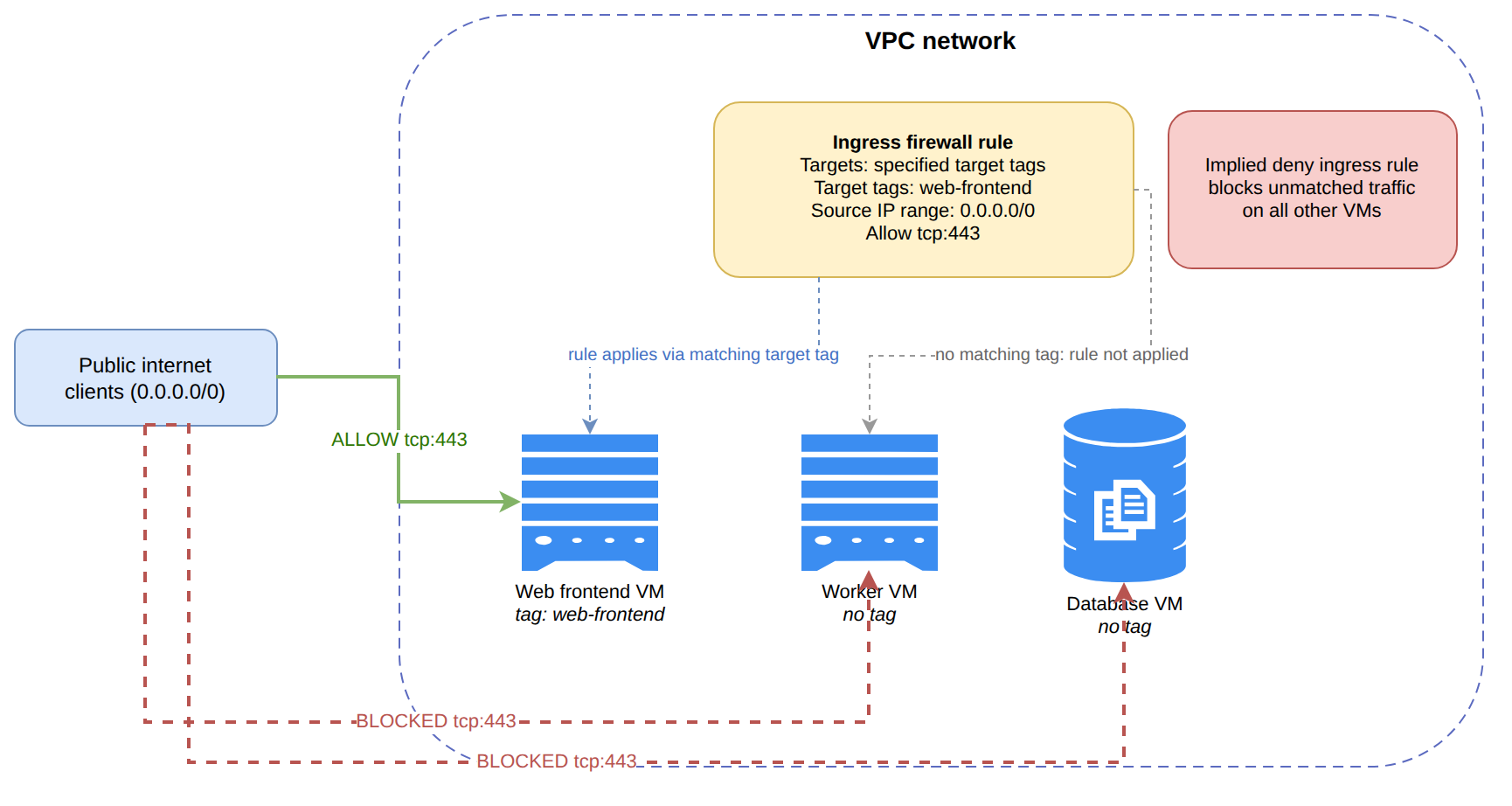
Key Advantages and Capabilities
- Granular targeting: Enables precise application of firewall rules to individual tiers without needing separate subnets or individual internal IP address listings.
- Dynamic scalability: New web server instances launched with the predefined network tag automatically inherit the appropriate firewall rule without requiring network rule updates.
- Simplified management: Reduces operational overhead by decoupling firewall policy definitions from VM IP address allocation.
- Stateful filtering: Google Cloud VPC firewall rules are stateful; allowing ingress TCP port 443 automatically permits corresponding return egress traffic.
Why This Is Optimal
Using network tags to specify targets is Google Cloud's foundational method for defining security boundaries among VM instances within the same subnet or VPC. It satisfies all functional and security requirements cleanly while adhering to standard GCP network management practices.
Create an egress firewall rule allowing TCP port 443, specify destination IP range 0.0.0.0/0, and apply target tags for database and worker instances.
Create an egress firewall rule allowing TCP port 443, specify destination IP range 0.0.0.0/0, and apply target tags for database and worker instances.
What Egress Rules Do
Egress firewall rules regulate outbound network traffic originating from Compute Engine VM instances to external or internal destinations. They do not manage or filter incoming traffic originating from the internet.
Why It Doesn't Meet the Requirement
- Controls outbound rather than inbound traffic: The scenario requires allowing incoming HTTPS requests from external internet clients to web servers. An egress rule governs traffic leaving instances, not incoming client requests.
- Targets the wrong VM instances: Applying tags to database and worker instances for an egress rule does not prevent them from receiving unsolicited inbound connections from the internet.
- Redundant rule: By default, Google Cloud includes an implied allow egress rule (priority
65535) that permits all outbound traffic from all instances unless explicitly overridden.
Key Characteristics and Limitations
- Directional control: Direction must be set to
INGRESSto evaluate incoming packets from clients. - Connection tracking: Because GCP firewalls are stateful, return traffic for established ingress connections is automatically permitted without requiring a paired egress allow rule.
This Answer Would Be Correct If
The requirement were to restrict or permit database and worker VMs from initiating outbound connections to external third-party HTTPS APIs over port 443.
Try 10 interactive questions like this one, free
Answer them yourself and get your score the moment you finish. No account needed.
Full access includes
- 2,014 practice questions across all 4 exam domains
- Every answer explained: why it is right, and why the others are not
- Scout, an AI tutor that answers your follow-up questions
- Readiness tracking by domain, so you know when to book the exam
Related free sample questions
Keep the momentum going with these hand-picked practice scenarios
FundamentalAssociate Cloud Engineer
Custom-Mode VPC Network
Setting up cloud networking
FundamentalAssociate Cloud Engineer
Static External IP with Cloud DNS A Record
Setting up cloud networking
FundamentalAssociate Cloud Engineer
Terraform GCS Remote State Backend
Infrastructure as code tooling (e.g., Fabric FAST, Config Connector, Terraform, Helm)
FundamentalAssociate Cloud Engineer
Organization Policy List vs Boolean Constraints
Applying organizational policies to the resource hierarchy
FundamentalAssociate Cloud Engineer
Cloud Billing Budget Email and Pub/Sub Alerts
Establishing billing budgets and alerts
FundamentalCloud Digital Leader
NoSQL Document Database Model
Define key data management concepts and terms, including: relational, non-relational, object storage, structured query language (SQL), and NoSQL.
Last updated