Fundamental
Prepare and test your skills
Fundamental
Prepare and test your skills
Vision API Image Tagging, Text and Moderation
Free sample question with answers and detailed explanation below. The Cloud Digital Leader practice bank has an additional 3,070 practice questions.Try 10 free realistic questions: instant score, no credit card, and no account required.
An e-commerce company wants to automate how it processes thousands of images uploaded daily by sellers and customers. The company needs a pre-trained Google Cloud service that can address the following business requirements without training custom machine learning models:
- Customer-facing discovery: Automatically assign general category tags to photos and locate multiple individual items with bounding boxes in a single image.
- Operations: Extract printed and handwritten text from uploaded photos of shipping labels and receipts.
- Compliance: Screen uploaded photos to detect and flag explicit, violent, or unsafe visual content before publication.
Which Google Cloud service should the company use?
Explanations
Cloud Data Loss Prevention API
Cloud Data Loss Prevention API
What Cloud Data Loss Prevention API is
Cloud Data Loss Prevention (DLP) API (part of Sensitive Data Protection) is a compliance and security service designed to discover, classify, and de-identify sensitive data—such as Personally Identifiable Information (PII), credit card numbers, and medical identifiers—across storage repositories and data streams.
Why it doesn't meet the requirement
While Cloud Data Loss Prevention API addresses data compliance, it is specialized for sensitive data discovery and redaction rather than general computer vision. It does not generate general product category tags (LABEL_DETECTION), locate multiple retail objects with bounding polygons (OBJECT_LOCALIZATION), or rate images across SafeSearch explicit content categories (adult, spoof, medical, violence, and racy).
Key characteristics and limitations
- Sensitive data inspection: Scans structured and unstructured data using predefined and custom detectors (
infoTypes) to locate sensitive identifiers. - De-identification and masking: Protects confidential data through redaction, masking, bucketing, or cryptographic tokenization.
- Storage classification pipelines: Integrates with Cloud Storage, Pub/Sub, and Cloud Run functions to automatically classify sensitive files uploaded to buckets.
- Not a general computer vision API: Lacks general image labeling, landmark detection, logo recognition, and visual content moderation features.
This answer would be correct if
The company needed to scan uploaded files in Cloud Storage to automatically detect, classify, and redact sensitive customer PII such as social security numbers, phone numbers, or payment card details.
Additional context
Students often confuse Cloud Data Loss Prevention API with Cloud Vision API when a scenario mentions compliance screening. However, moderating user-uploaded photos for explicit or violent imagery is a visual content moderation task handled by Cloud Vision API (SAFE_SEARCH_DETECTION), whereas Cloud Data Loss Prevention API focuses on protecting regulated confidential data and PII.
Text-to-Speech API
Text-to-Speech API
What Text-to-Speech API is
Text-to-Speech API is a pre-trained Google Cloud artificial intelligence service that converts written text into natural-sounding synthetic human speech. It enables developers to add voice interfaces and audio playback capabilities to applications and devices.
Why it doesn't meet the requirement
Text-to-Speech API is an audio generation service that requires machine-readable text as its input. It has no computer vision capabilities and cannot inspect uploaded photographs to detect objects (OBJECT_LOCALIZATION), assign image labels (LABEL_DETECTION), extract text from images (TEXT_DETECTION), or moderate explicit visual content (SAFE_SEARCH_DETECTION).
Key characteristics and limitations
- Synthetic voice generation: Converts plain text or Speech Synthesis Markup Language (
SSML) into playable audio formats such asMP3orLINEAR16. - Customizable audio profiles: Supports multiple languages, voices, pitch adjustments, and speaking rates.
- Unidirectional text-to-audio workflow: Generates audio output from text strings rather than extracting information from visual media.
- No image inspection: Cannot parse pixels, bounding boxes, or visual safety categories.
This answer would be correct if
The company wanted to improve accessibility by reading product descriptions aloud to visually impaired users or generating automated voice prompts for a customer service phone system.
Additional context
While Text-to-Speech API cannot process images on its own, it is often chained downstream of Cloud Vision API and Cloud Translation API in accessibility workflows—where Cloud Vision API extracts text from a photo via OCR, Cloud Translation API translates the text, and Text-to-Speech API speaks the translated result aloud.
Cloud Vision API
Cloud Vision API
What Cloud Vision API is
Cloud Vision API is a pre-trained machine learning service that enables developers to derive insights from images and documents without building or training custom computer vision models. It exposes ready-to-use REST and RPC endpoints that analyze visual files stored locally or in Cloud Storage.
How it meets the business requirements
- Customer-facing discovery: Through label detection (
LABEL_DETECTION), the service identifies general objects, products, activities, and locations across broad categories. Using object localization (OBJECT_LOCALIZATION), it detects multiple distinct items in a single photo and returns normalized bounding box coordinates for each item. - Operations: Using Optical Character Recognition (OCR) via
TEXT_DETECTION(for sparse text like signs or labels) andDOCUMENT_TEXT_DETECTION(optimized for dense text, PDF/TIFF files, and handwriting), it extracts machine-coded UTF-8 text from receipts and shipping labels. - Compliance: Through SafeSearch detection (
SAFE_SEARCH_DETECTION), it evaluates images for explicit or unsafe content and returns likelihood ratings across five categories:adult,spoof,medical,violence, andracy.
Cloud Vision API Feature Mapping
Hierarchy / Taxonomy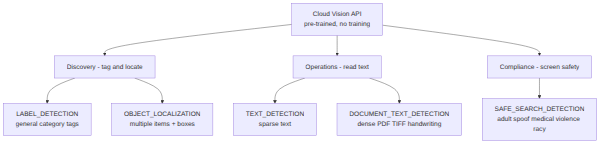
Key advantages and capabilities
- Zero model training required: Provides immediate access to pre-trained models for image classification, object localization, OCR, and content moderation.
- Asynchronous batch annotation: Supports offline batch processing of up to 2,000 image files in a single asynchronous request, storing JSON outputs directly in Cloud Storage.
- Comprehensive visual features: Includes specialized capabilities for logo detection (
LOGO_DETECTION), landmark detection (LANDMARK_DETECTION), face detection (FACE_DETECTION), and crop hints (CROP_HINTS). - Seamless ecosystem integration: Easily connects with Cloud Storage, Pub/Sub, and Cloud Run functions to build event-driven image processing pipelines.
Why this is optimal
Unlike services focused on text translation, audio synthesis, or sensitive text classification, Cloud Vision API is purpose-built for visual content analysis and addresses all three operational, compliance, and customer-facing image requirements through a single pre-trained API.
Cloud Translation API
Cloud Translation API
What Cloud Translation API is
Cloud Translation API is a pre-trained machine learning service designed to dynamically translate text strings and documents between dozens of different human languages. It helps organizations localize applications, websites, and textual data for global audiences.
Why it doesn't meet the requirement
Cloud Translation API operates on text inputs rather than raw image pixels. It cannot analyze photographs to identify objects, generate visual bounding boxes, perform Optical Character Recognition (OCR) on receipts, or evaluate images for explicit visual content (SAFE_SEARCH_DETECTION).
Key characteristics and limitations
- Text-to-text processing: Accepts source text in one language and returns translated text in a target language.
- Language detection: Automatically identifies the source language of input text when the origin language is unknown.
- Glossary support: Allows businesses to define custom terminology and brand-specific glossaries to ensure consistent translations.
- No native computer vision capabilities: Cannot directly inspect image files (
JPEG,PNG,TIFF) unless paired with an upstream vision service that extracts text first.
This answer would be correct if
The scenario required converting English product descriptions, customer reviews, or extracted image labels into multiple international languages to support global e-commerce shoppers.
Additional context
In multi-service architectures, Cloud Translation API is frequently paired with Cloud Vision API. Because Cloud Vision API returns image labels (LABEL_DETECTION) in English only, applications can pass those English labels—or text extracted via TEXT_DETECTION—directly to Cloud Translation API to localize the output into other languages.
Try 10 interactive questions like this one, free
Answer them yourself and get your score the moment you finish. No account needed.
Full access includes
- 3,070 practice questions across all 6 exam domains
- Every answer explained: why it is right, and why the others are not
- Scout, an AI tutor that answers your follow-up questions
- Readiness tracking by domain, so you know when to book the exam
Related free sample questions
Keep the momentum going with these hand-picked practice scenarios
FundamentalCloud Digital Leader
Cloud Text-to-Speech API
Select which Google Cloud pre-trained API best applies to different business use cases, including: Natural Language API, Vision API, Cloud Translation API, Speech-to-Text API, and Text-to-Speech API.
FundamentalCloud Digital Leader
Natural Language API vs Translation API
Select which Google Cloud pre-trained API best applies to different business use cases, including: Natural Language API, Vision API, Cloud Translation API, Speech-to-Text API, and Text-to-Speech API.
FundamentalCloud Digital Leader
BigQuery Serverless Data Warehouse
Determine which Google Cloud data management products are applicable to different business use cases.
FundamentalCloud Digital Leader
Regional Persistent Disks Synchronous Replication
Discuss the fundamental concepts of modern operations, reliability, and resilience in the cloud.
FundamentalCloud Digital Leader
Google Global Private Network Backbone
Describe the benefits of Google designing and building its own data centers, using purpose-built servers, networking, and custom security hardware / software.
IntermediateProfessional Cloud Architect
Cloud FinOps
Business use cases and product strategy
Last updated