Fundamental
Prepare and test your skills
Fundamental
Prepare and test your skills
Loading Raw Data with ELT in BigQuery
Free sample question, answered and explained below. The Associate Data Practitioner practice bank has 1,156 more like it. Try 10 free: instant score, no account.
A digital marketing agency collects massive daily volumes of unstructured and semi-structured campaign data from various external platforms. The team wants to ingest all raw data into Google Cloud as quickly as possible without creating preprocessing bottlenecks, preserving the raw logs so they can transform them on demand using SQL-based tools like Dataform.
Which data integration strategy should the agency implement?
Explanations
A transactional replication pattern that continuously ingests and stores raw unstructured logs directly into Cloud SQL
A transactional replication pattern that continuously ingests and stores raw unstructured logs directly into Cloud SQL
What transactional replication into Cloud SQL is
Cloud SQL is a fully managed relational database service (supporting MySQL, PostgreSQL, and SQL Server) optimized for OLTP (Online Transaction Processing) workloads requiring low-latency, row-level transactions.
Why it doesn't meet the requirement
- Incompatible with unstructured data (✗): Cloud SQL requires strict relational tabular schemas and is unsuited for massive unstructured log ingestion.
- Scaling and storage limits (✗): Relational databases have storage constraints and are not designed to efficiently handle petabyte-scale analytical log ingestion.
- Poor analytical transformation performance (✗): Querying and transforming high-volume log data using transactional SQL engines causes performance degradation.
Key characteristics and limitations
- OLTP optimization: Built for transactional consistency (ACID compliance) rather than large-scale analytical transformations.
- Vertical scaling: Relational instances scale primarily vertically, making them cost-prohibitive for high-volume raw data dumping.
- Schema dependency: Requires schema validation upon insert, conflicting with variable, raw log formats.
This answer would be correct if
The scenario involved replicating relational database transactions from an on-premises transactional database into a managed cloud database for live transactional application serving.
Additional context
For unstructured data analytics, BigQuery paired with object storage and BigLake/external tables provides superior scalability compared to transactional relational databases.
A traditional ETL (Extract, Transform, Load) pattern that cleanses and structures all raw data on an intermediate server prior to ingestion
A traditional ETL (Extract, Transform, Load) pattern that cleanses and structures all raw data on an intermediate server prior to ingestion
What traditional ETL is
ETL (Extract, Transform, Load) is a data integration pattern where data is extracted from source systems, transformed and structured in an external compute layer (such as Cloud Data Fusion or a dedicated processing cluster), and finally loaded into the target storage destination.
Why it doesn't meet the requirement
- Transformation bottlenecks (✗): Processing massive volumes of unstructured data before loading requires substantial intermediate compute resources and creates ingestion delays.
- Loss of raw data flexibility (✗): Transforming data before storage discards unparsed raw fields, preventing future on-demand queries against the original schema.
- Underutilization of warehouse capabilities (✗): It fails to take advantage of BigQuery's scalable query engine to perform in-place transformations.
Key characteristics and limitations
- Rigid schema definitions: Requires target schemas to be predefined before data ingestion can occur.
- Separate compute overhead: Demands provisioning and maintaining intermediate transformation pipelines outside the data warehouse.
- Potential scaling limits: Intermediate processing pipelines can become operational bottlenecks during unexpected spikes in high-volume ingestion.
This answer would be correct if
The scenario required strict data cleansing for compliance or privacy reasons before data touches the cloud warehouse, or if the organization had legacy transformation systems designed to minimize BigQuery compute consumption.
Additional context
While tools like Cloud Data Fusion effectively implement ETL when required, ELT remains the preferred pattern for high-volume analytics workloads in modern cloud environments.
A reverse ETL pattern that exports curated metrics from analytical tables back into operational SaaS systems
A reverse ETL pattern that exports curated metrics from analytical tables back into operational SaaS systems
What reverse ETL is
Reverse ETL is the process of extracting transformed, enriched data and analytical insights from a centralized data warehouse like BigQuery and loading them into operational downstream tools, such as CRM systems, marketing platforms, or customer support databases.
Why it doesn't meet the requirement
- Wrong pipeline direction (✗): Reverse ETL is an egress process for operationalizing already-transformed warehouse data, not an ingestion strategy for raw source data.
- No ingestion handling (✗): It does not address the requirement to ingest high-volume, unstructured raw data from external sources into Google Cloud.
Key characteristics and limitations
- Post-analytics stage: Executes only after data has already been ingested, modeled, and analyzed in the warehouse.
- Operational focus: Primarily used to empower business applications with warehouse data (e.g., syncing customer lead scores to Salesforce).
- Not an ingestion mechanism: Cannot replace primary ingestion patterns like ETL or ELT.
This answer would be correct if
The scenario stated that marketing teams had already modeled customer churn scores in BigQuery and needed to push those scores back to external advertising platforms or CRM applications.
Additional context
Reverse ETL complements ELT pipelines by closing the loop between analytical insight generation and operational business execution.
An ELT (Extract, Load, Transform) pattern that loads raw data directly into BigQuery and applies in-warehouse transformations
An ELT (Extract, Load, Transform) pattern that loads raw data directly into BigQuery and applies in-warehouse transformations
What the ELT pattern is
The ELT (Extract, Load, Transform) pattern is a modern data integration architecture where data is extracted from source systems, loaded directly in its raw format into a scalable data warehouse such as BigQuery, and then transformed inside the destination engine using SQL, Dataform, or Data Manipulation Language (DML).
ELT Load-then-Transform Flow in BigQuery
Process Flow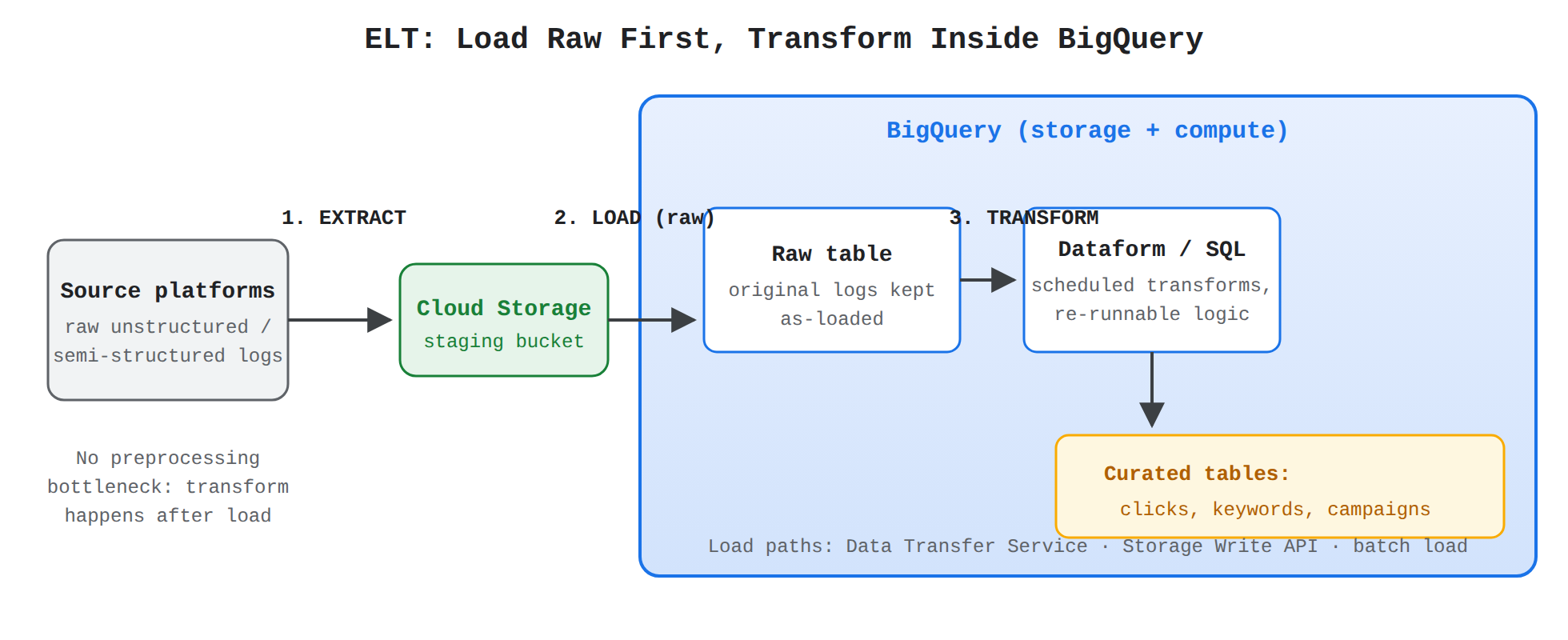
How it meets the requirements
- Fast ingestion without bottlenecks (✓): Loading raw data directly into BigQuery decouples data ingestion from compute-heavy processing, eliminating upstream transformation bottlenecks.
- Handling high-volume unstructured data (✓): Modern cloud data warehouses provide virtually limitless storage and scalable compute, making them ideal for landing large volumes of raw, semi-structured, or unstructured datasets.
- On-demand and flexible transformations (✓): By storing raw data in BigQuery, analysts can schedule downstream transformations using Dataform or SQL views and modify transformation logic repeatedly without re-extracting data from sources.
Key advantages and capabilities
- Scalable compute engine: Utilizes BigQuery's distributed SQL engine to execute high-performance transformations across massive datasets.
- Data preservation: Retains original raw data records, allowing teams to create new metrics and audit historical data retroactively.
- Simplified architecture: Reduces the need for intermediate transformation clusters before ingestion, lowering infrastructure management overhead.
- Orchestration integration: Integrates natively with tools like BigQuery Data Transfer Service and Dataform for automated scheduling and version control.
Why this is optimal
Compared to legacy ETL patterns, ELT maximizes the native parallel processing and storage scalability of BigQuery, minimizing data loading latency and providing flexibility for rapidly evolving analytical requirements.
Try 10 interactive questions like this one, free
Answer them yourself and get your score the moment you finish. No account needed.
Full access includes
- 1,156 practice questions across all 4 exam domains
- Every answer explained: why it is right, and why the others are not
- Scout, an AI tutor that answers your follow-up questions
- Readiness tracking by domain, so you know when to book the exam
Related questions
Keep the momentum going with these hand-picked practice scenarios
FundamentalAssociate Data Practitioner
ELT vs ETL
Evaluate use cases for ELT and ETL
FundamentalAssociate Data Practitioner
ELT with BigQuery Data Transfer Service and Dataform
Evaluate use cases for ELT and ETL
FundamentalAssociate Data Practitioner
Pub/Sub to BigQuery Streaming Ingestion
Identify use cases for event-driven data ingestion from Pub/Sub to BigQuery
FundamentalAssociate Data Practitioner
BigQuery ML ML.FORECAST
Perform inference using BigQuery ML models
FundamentalAssociate Data Practitioner
Backup and DR Service
Compare backup and recovery solutions offered as Google-managed services
FundamentalGenerative AI Leader
AI ML Generative AI Hierarchy
Defining core gen AI concepts (e.g., artificial intelligence, natural language processing, machine learning, generative AI, foundation models, multimodal foundation models, diffusion models, prompt tuning, prompt engineering, large language models)
Last updated