Professional Cloud Security Engineer
Prepare and test your skills
Prepare and test your skills
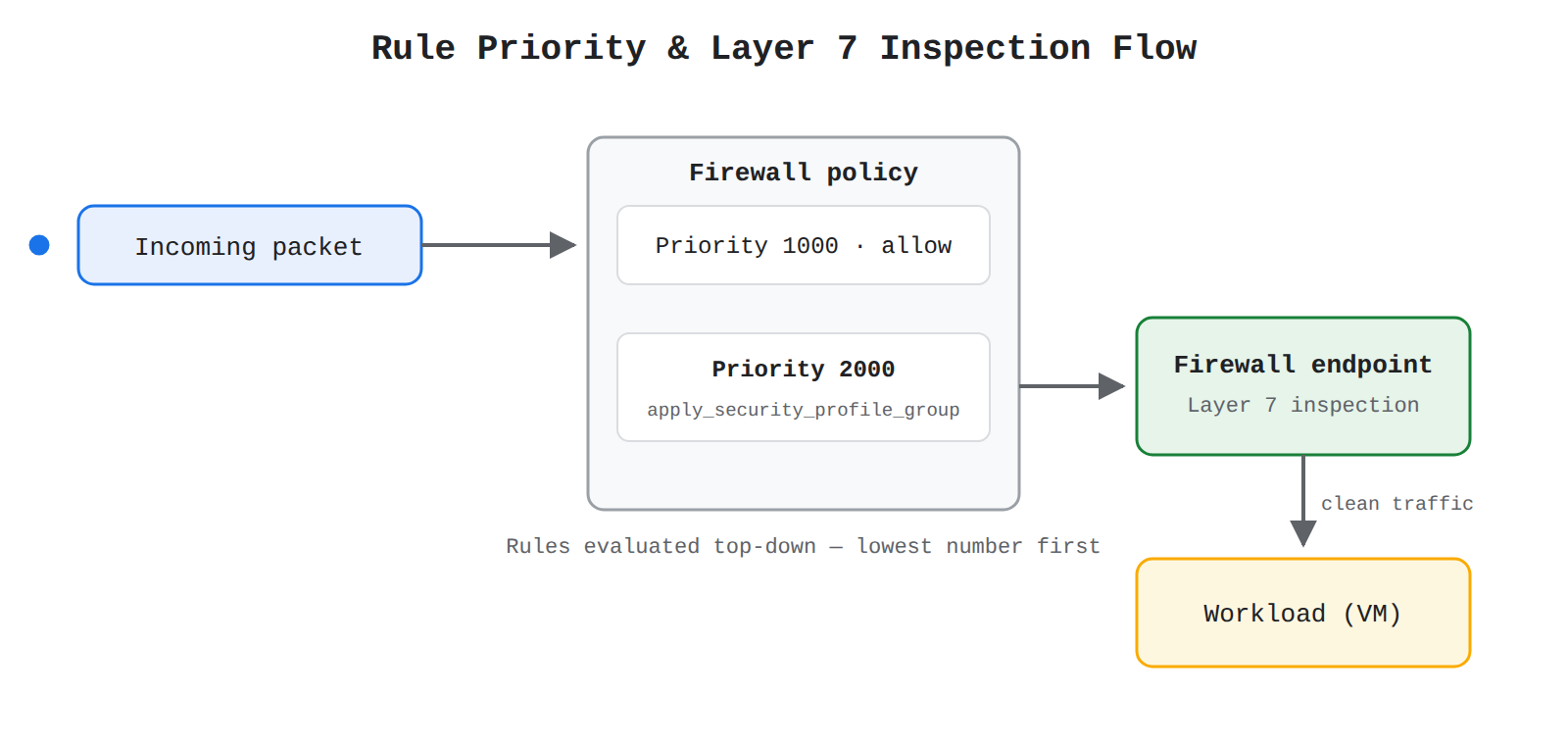
A process flow showing an incoming packet entering a Cloud NGFW firewall policy, where rules are evaluated top-down by priority: priority 1000 does not match, priority 2000 with the apply_security_profile_group action matches and forwards the traffic to a firewall endpoint for Layer 7 inspection, after which the traffic is delivered to the workload VM.
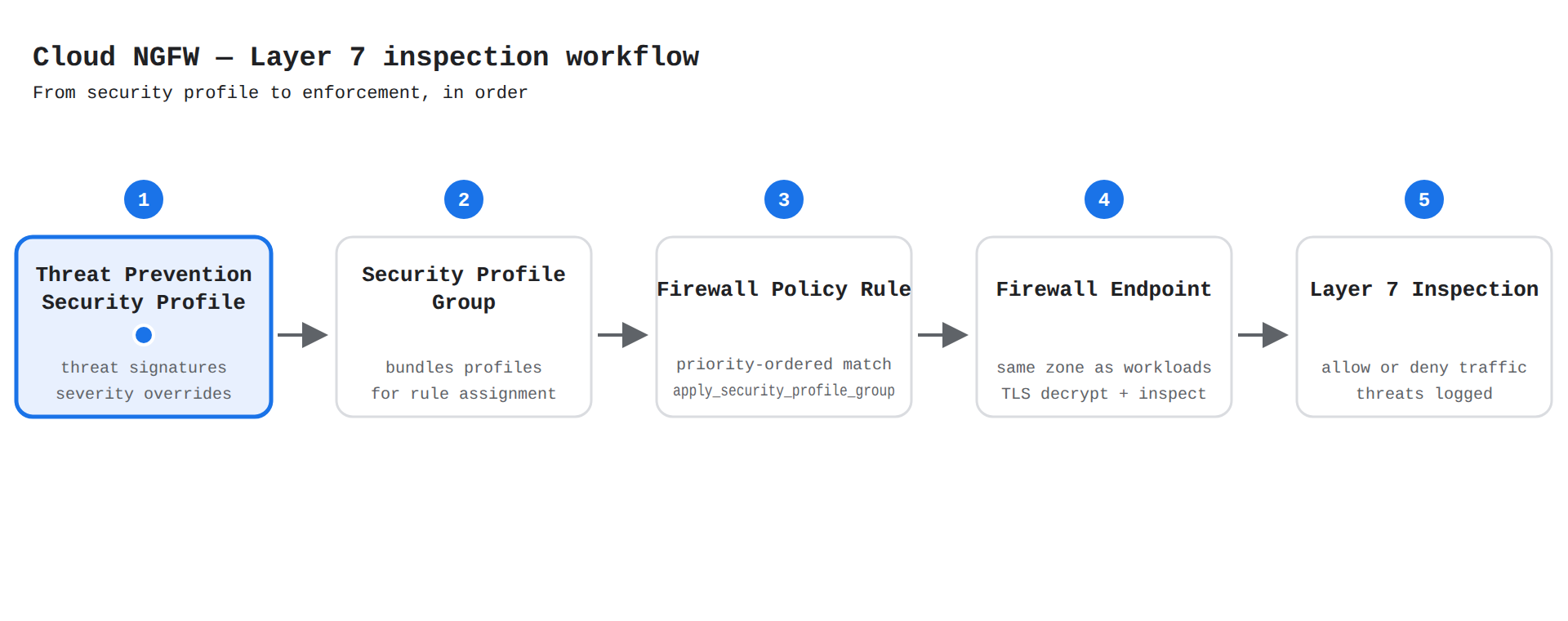
A five-step process flow of the Cloud NGFW Layer 7 inspection workflow: a threat prevention security profile is bundled into a security profile group, referenced by a firewall policy rule with the apply_security_profile_group action, enforced at a zonal firewall endpoint with TLS inspection, and used to allow or deny traffic. A packet marker travels left to right highlighting each step in order, ending with logs exported to Google Security Operations and Firewall Insights for tuning overrides.
Enabling Layer 7 inspection requires Threat Prevention Security Profiles to define threat signatures and severity overrides, Security Profile Groups to bundle those profiles, and Firewall Endpoints to serve as dedicated zonal processing points. Administrators can also enable TLS inspection within the configuration to decrypt and inspect encrypted traffic flows.
Administrators tune inspection profiles by setting threat or severity overrides based on application criticality and formal risk assessments. This allows organizations to suppress low-severity alerts for non-critical development applications while enforcing strict blocking rules on critical production workloads.
Integrating Cloud NGFW logs imports firewall events into Google Security Operations and maps them to the Unified Data Model (UDM) for standardization across telemetry sources. This mapping enables security teams to correlate firewall events, write detection rules, search log data, and investigate threats using advanced analytical tools.
Firewall Insights analyzes rule usage to identify shadowed configurations that never match, overly permissive rules, and unused allow rules that may introduce security risks. Security teams use these findings alongside Firewall Rules Logging to audit real traffic patterns and continuously tighten access boundaries.
Cloud NGFW generates detailed logs that capture network traffic patterns, threat detections, and firewall policy actions. To analyze this data, you must first configure log export from Cloud NGFW to a centralized location, typically a Cloud Storage bucket. This process transforms raw firewall logs into a structured format, extracting fields like connection details, rule matches, and threat intelligence. Proper permissions must be set on the bucket to allow access for security analysis tools.
Integrating Cloud NGFW logs with Google Security Operations (formerly Chronicle) enables advanced security analytics and incident response. You set up feeds that import the logs into the platform, where they are mapped to the Unified Data Model (UDM). This mapping standardizes firewall events so they can be correlated with other data sources. Security teams can then create detection rules, search across log data, and investigate potential threats using the platform’s analytical tools, turning raw logs into actionable intelligence.
Firewall Insights provides additional analysis by examining firewall rule usage and identifying optimization opportunities. It can detect overly permissive rules, shadowed rules that never match, and unused allow rules that may pose security risks. For comprehensive monitoring, integrate Cloud NGFW logs with Security Command Center and broader incident response workflows. This integration allows security teams to correlate firewall events with other telemetry, enabling faster detection and response to threats through custom alerts and automated playbooks.
Traditional network firewalls evaluate traffic based on IP addresses and ports, but Cloud NGFW with Global Network Firewall Policies supports application-layer security by inspecting full packet payloads and protocol behavior. Enabling Layer 7 inspection requires orchestrating several components: Threat Prevention Security Profiles define threat signatures and severity overrides, Security Profile Groups bundle these profiles for assignment, and Firewall Endpoints provide dedicated zonal processing points. To minimize latency, firewall endpoints must be provisioned in the same zone as the workloads requiring inspection. Administrators can also enable TLS inspection within the security configuration to decrypt and inspect encrypted traffic flows.
Within a firewall policy, each rule is evaluated according to a unique Priority number that determines the order of execution. When a rule uses the apply_security_profile_group action, packets matching the rule are transparently forwarded to the firewall endpoint for Layer 7 inspection. These granular rules can enforce perimeter controls using Secure tags and service accounts to establish identity-aware boundaries. Rules can be managed through project-level global policies or organization-wide Hierarchical Firewall Policies to ensure consistent baseline security across the enterprise.
Continuous monitoring ensures application-based security rules remain effective. Export Cloud NGFW telemetry to Google Security Operations to map threat and connection data into the Universal Data Model (UDM) for advanced analytics. Using Firewall Rules Logging alongside Firewall Insights helps identify shadowed configurations and overly permissive rules. By enabling logging, organizations can continuously audit traffic and tighten access rules, optimizing their security boundaries based on real traffic patterns.
Implementing Layer 7 threat inspection begins by defining a Threat Prevention Security Profile that specifies which threats to detect and block. This profile is placed into a Security Profile Group, which serves as an organizational container. You then create a firewall policy rule using the apply_security_profile_group action, directing matched traffic to a Firewall Endpoint for deep packet inspection. The entire workflow ensures that only traffic matching the rule criteria is inspected, balancing security with performance.
Tuning inspection profiles is critical for balancing security efficacy with performance. You can adjust the sensitivity of the intrusion detection/prevention system (IDS/IPS) and malware scanning based on the criticality of the application and a formal risk assessment. This is done by creating threat or severity overrides within the Threat Prevention profile. For example, you might suppress low-severity alerts for a non-critical development application while enforcing strict blocking rules for a production financial service. Tuning ensures controls are appropriate for the actual risk level of the protected assets.
Advanced deployment includes enabling TLS inspection to decrypt and analyze encrypted traffic, which is essential for comprehensive Layer 7 security. Firewall Endpoints must be deployed in the same zone as the workloads they protect and associated with the correct VPC networks. Inspection policies can be applied using Global Network Firewall Policies or Hierarchical Firewall Policies, allowing for centralized or granular management aligned with your organizational structure. Proper placement and policy selection minimize latency and ensure consistent enforcement.
Operationalizing the solution requires continuous validation. Export Cloud NGFW logs to a security information and event management (SIEM) system like Google Security Operations for analysis. By creating custom detection rules and reviewing attack patterns, you can verify that your tuning decisions are effective and adapt profiles to evolving threats. This iterative process ensures that your perimeter security remains robust and responsive to actual traffic patterns and observed threats.
A security engineer is designing an application-layer intrusion detection strategy for a mission-critical financial processing workload running across multiple zones in a single Google Cloud region. The workload experiences a sustained traffic volume of 12 Gbps, requires deep Layer 7 inspection of both ingress/egress and east-west intra-subnet lateral communications for malware and command-and-control activity, and must identify applications regardless of the ports used.
During testing, specific benign internal maintenance tasks triggered false-positive alerts against standard intrusion signatures.
Which configuration should the security engineer deploy to inspect this application traffic and tune the detection profile?
 StudyCerts
 StudyCerts