Professional Cloud Security Engineer
Prepare and test your skills
Prepare and test your skills
Context-Aware Access (CAA) adds a powerful layer of security by checking more than just a username and password. It evaluates the context of a login attempt, such as the user's device security, geographic location, and IP address, before granting access to applications and data. This means that even if a password is stolen, an attacker logging in from an unsecured device or a suspicious location can still be blocked. CAA rules are enforced through the Identity-Aware Proxy (IAP), which acts as a secure gatekeeper for your applications, checking every access request against your policies.
Managing user sessions is a key part of this security. You must set rules for how long a login session lasts and when users need to log in again. It's important to coordinate these session rules with any external identity providers you use for single sign-on (SSO), so security is consistent everywhere. For the strongest protection, you can require Titan Security Keys for two-factor authentication. These physical keys use cryptography to prove a user's identity, making them highly resistant to phishing attacks where users are tricked into entering their credentials on fake websites.
A strong first line of defense is creating and enforcing a detailed password policy. Within Cloud Identity or Google Workspace, administrators can set rules that force users to create complex passwords. These rules include minimum length, required mix of characters (like uppercase, lowercase, numbers, and symbols), and restrictions on reusing old passwords or including the username. You can also set passwords to expire after a certain time, ensuring credentials are regularly refreshed.
Passwords alone are not enough. Enforcing 2-Step Verification (2SV), also called multi-factor authentication (MFA), adds a critical second layer. This requires users to provide a second proof of identity, like a code from their phone or a tap on a Titan Security Key, whenever they sign in. Making 2SV mandatory, especially for administrators, drastically reduces the risk from stolen passwords. Tools like Security Command Center can monitor your organization to ensure these policies are being followed and alert you if they are bypassed.
Other essential controls include setting up secure account recovery methods and, crucially, governing session lifecycles. By limiting how long a login session is valid, you reduce the blast radius if someone's credentials are stolen. You can configure these session duration limits so that cached credentials automatically expire, forcing users to re-authenticate. Combining strong password rules, mandatory 2SV, and controlled session lengths creates a comprehensive defense for user accounts.
Session management involves setting specific time limits on user access to minimize risk. The two main time-based controls are the maximum session length and the idle session timeout. The maximum session length is the total time a user can stay logged in before the system forces a full logout. The idle session timeout automatically ends a session if the user is inactive for a set period, like 15 minutes, which protects against access from an unattended device. For especially sensitive actions, you can also require re-authentication even during an active session.
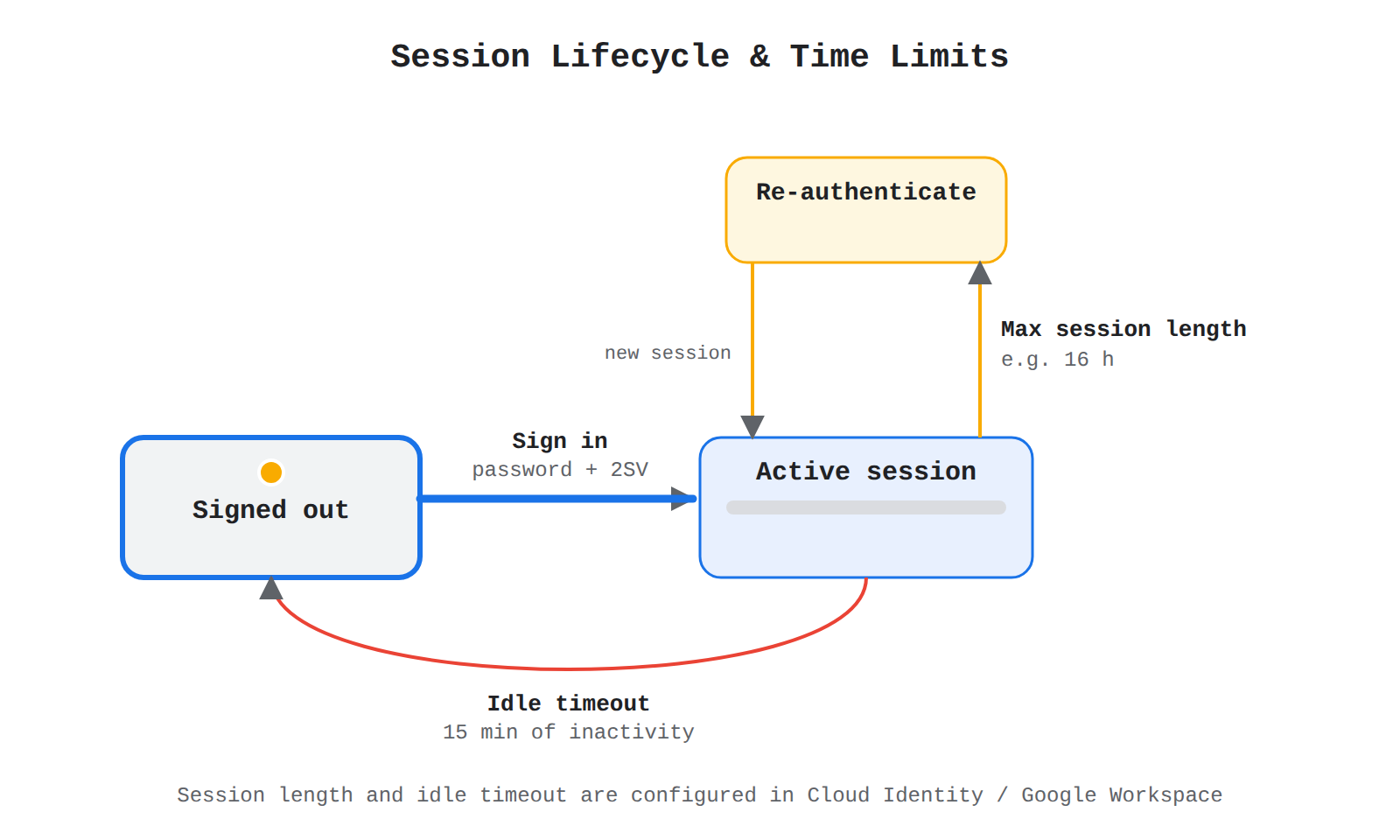
A state diagram showing a user moving from Signed out to an Active session via sign-in with password and 2SV, then either re-authenticating when the maximum session length is reached or being logged out by the idle timeout after 15 minutes of inactivity. A session clock bar fills while the session is active, and a marker travels the paths in order to show the lifecycle.
Beyond user sessions, you must also manage the lifecycles of tokens and keys used by applications. OAuth tokens and API keys grant access, so they need defined expiration times. More importantly, you need procedures to revoke these tokens immediately if they are leaked or if a user's account is compromised. This swift revocation is a key step in incident response, cutting off an attacker's access.
These session and token controls are configured within Cloud Identity or Google Workspace settings. You define the session length for Google Cloud services and establish policies for token management. Integrating these settings with monitoring tools like Security Command Center allows you to detect unusual activity and ensure your session security policies are being enforced across your entire cloud environment.
Context-Aware Access (CAA) adds a powerful layer of security by evaluating the context of a login attempt, such as the user's device security, geographic location, and IP address, before granting access to applications and data. This means that even if a password is stolen, an attacker logging in from an unsecured device or a suspicious location can still be blocked. CAA rules are enforced through the Identity-Aware Proxy (IAP), which acts as a secure gatekeeper for your applications.
The maximum session length is the total time a user can stay logged in before the system forces a full logout, while the idle session timeout automatically ends a session if the user is inactive for a set period, like 15 minutes. Both controls are used to minimize risk, with the idle timeout protecting against access from an unattended device.
Titan Security Keys are physical keys that use cryptography to prove a user's identity, making them highly resistant to phishing attacks where users are tricked into entering their credentials on fake websites. They can be used for two-factor authentication, providing a second proof of identity during sign-in.
Coordinating session rules with external identity providers ensures that security is consistent everywhere across your single sign-on (SSO) environment. Without this coordination, session policies may conflict or be bypassed, weakening the overall security posture.
An enterprise organization is establishing baseline authentication security controls across its Cloud Identity and Google Cloud environment. The security engineering team needs to enforce hardened authentication and recovery policies for privileged accounts (super administrators) while maintaining standard policies for general workforce users.
Specifically, the implementation must achieve the following requirements:
Which configuration strategy should the security engineer implement in the Google Admin console?
Keep all administrator and standard users in the root Organizational Unit (OU), configure global 2-Step Verification using SMS or voice codes, and enable automated email password recovery.
Configure Workload Identity Federation with SAML 2.0 assertion encryption for all super administrators and grant them the Service Account Token Creator role on host project service accounts.
Use Policy Analyzer on the root organization node to enforce session expiration intervals, and configure automated OAuth client ID secret rotation every 24 hours.
Create a dedicated Organizational Unit (OU) for super administrator accounts, enforce 2-Step Verification requiring Security Keys only on that OU, and disable automated non-admin account recovery.
 StudyCerts
 StudyCerts