Professional Cloud Security Engineer
Prepare and test your skills
Prepare and test your skills
Policy Analyzer allows security teams to run structured queries across the Google Cloud resource hierarchy to discover which principals hold access to specific resources. The analysis engine evaluates direct role bindings as well as inherited permissions originating from parent folders and organizations. By gathering and evaluating these access layers together, the service provides an accurate view of true effective permissions across all cloud assets. This visibility allows organizations to verify least-privilege enforcement and maintain strict security governance.
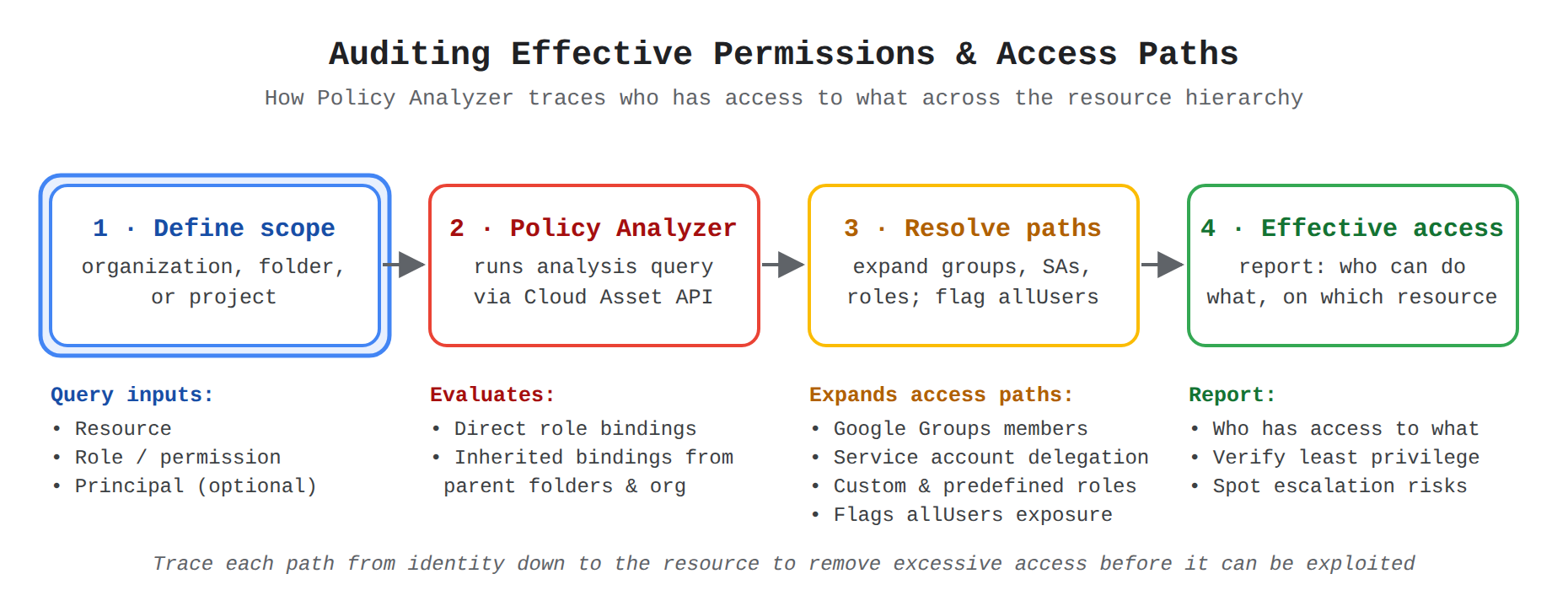
A four-step process flow showing how Policy Analyzer audits effective permissions: define a query scope, run the analysis across direct and inherited role bindings, resolve access paths through group expansion, service account delegation, role expansion, and public exposure flags, then produce an effective-access report for least-privilege verification. The animation highlights each step in order while a pulse travels along the connecting arrows.
Access paths in modern cloud environments often span multiple nested identities and role configurations. Policy Analyzer resolves these complex paths by expanding memberships inside Google Groups, auditing delegations tied to service accounts, and breaking down custom and predefined roles. It also flags public exposures by detecting broad identifiers such as allUsers or allAuthenticatedUsers. Tracing these authorization paths from the identity down to the resource helps engineers spot indirect privilege escalation risks and remove excessive access before it can be exploited.
Regularly auditing authorization paths helps organizations fulfill strict regulatory requirements without interrupting production workloads. Security teams can rapidly isolate unauthorized access paths, inspect high-risk administrative grants, and diagnose permission issues across projects. Combining policy analysis with perimeter controls like VPC Service Controls establishes layered defense boundaries that protect sensitive enterprise data.
IAM Recommender monitors actual permission usage over a defined observation period to detect unused permissions and close security gaps. The service compares historical activity against current role grants to identify where broad roles can be replaced with more granular permissions. For example, it highlights instances where a broad role like Project Editor can safely transition to a scoped role like Compute Instance Admin. This automated analysis allows administrators to reduce the attack surface of critical workloads without guesswork.
Before applying recommended changes, security teams must evaluate key impact metrics, such as the total number of permissions that will be revoked. Verifying the length of the observation period ensures that the recommendation reflects full operational cycles rather than incomplete usage data. Organizations can automate the remediation process by sending JSON payloads from the Recommender API to orchestration platforms like Google SecOps SOAR for staged, auditable rollouts.
Beyond individual recommendations, policy insights aggregate security posture trends across the entire resource hierarchy to reveal systemic vulnerabilities. These insights detect unused credentials on service accounts and highlight resources that fall outside established perimeter boundaries. Additionally, lateral movement insights map out risky permission combinations across identities, enabling administrators to close potential attack paths before adversaries can abuse them.
IAM Policy Simulator enables security engineers to safely test changes to role bindings, IAM conditions, and deny policies prior to production deployment. The service evaluates proposed policy modifications against real-world resource access patterns and generates an impact report that highlights which permissions would be granted or revoked. Up to 10 simulations can run concurrently, with each test progressing through an In progress, Completed, or Error state. This simulation workflow prevents accidental permission grants and protects critical production services from unexpected outages.
After reviewing the simulation report and comparing the proposed configuration against the active policy, administrators choose between several operational paths:
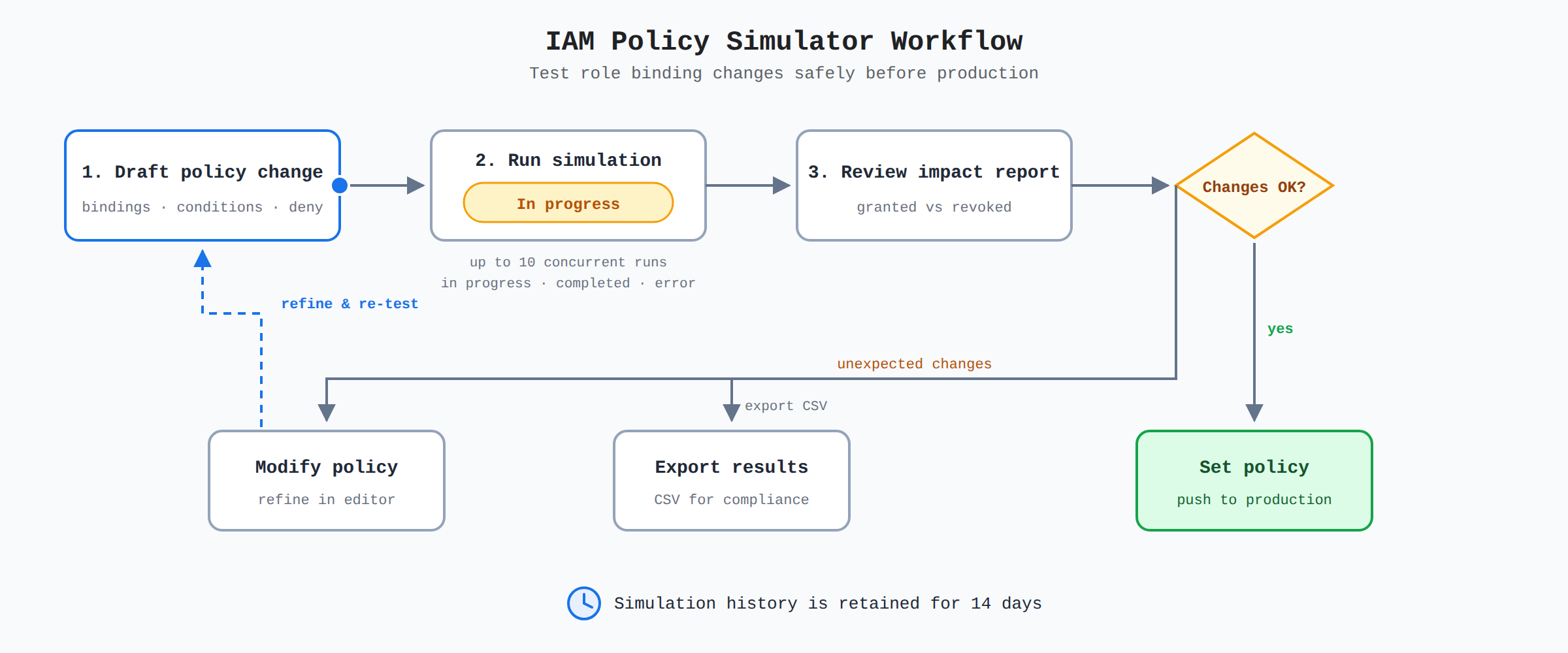
A process flow of the IAM Policy Simulator workflow: draft a policy change, run a simulation (status moves from In progress to Completed, with up to 10 concurrent runs), review the impact report of granted and revoked permissions, then either set the policy to production, modify and re-test, or export results to CSV. A note records that simulation history is retained for 14 days.
When unexpected access behavior occurs in production, IAM Policy Troubleshooter determines the root cause of access denials or unintended allowances. The tool traces effective access by analyzing the entire resource hierarchy, evaluating inheritance rules, conditional bindings, and individual role bindings. To support compliance audits and change tracking, Google Cloud maintains a simulation history for 14 days, allowing security teams to review past simulations, their execution dates, and their final outcomes.
IAM Policy Simulator tests proposed changes to role bindings, IAM conditions, and deny policies before deployment, whereas IAM Policy Troubleshooter diagnoses existing access behavior to determine the root cause of production access denials or unintended allowances. While the simulator allows teams to evaluate impact reports and immediately apply, refine, or export proposed policy changes, the troubleshooter traces live effective access across hierarchy inheritance rules, conditional bindings, and role bindings. Additionally, Google Cloud retains policy simulation history for 14 days to track past simulation runs and outcomes.
Policy Analyzer determines true effective permissions by executing structured queries that evaluate direct role bindings alongside inherited permissions from parent folders and organizations. It resolves complex access paths by expanding Google Groups memberships, auditing service account delegations, inspecting custom and predefined roles, and detecting public exposures like allUsers or allAuthenticatedUsers. Tracing these full authorization paths enables security teams to identify indirect privilege escalation risks and enforce least-privilege access.
IAM Recommender identifies opportunities by monitoring actual permission usage over an observation period and comparing historical activity against existing role grants. It flags broad role assignments that can be replaced with more granular permissions, such as transitioning from Project Editor to Compute Instance Admin. To prevent disruptions, administrators can assess impact metrics, such as the count of revoked permissions, and send Recommender API JSON payloads to Google SecOps SOAR for automated remediation.
A security engineer is evaluating IAM Role Recommendations in Google Cloud to transition an automated data processing service account away from the overly broad roles/editor basic role. While analyzing the recommendation in the Google Cloud console, the engineer notes the following details:
roles/editor with a narrower predefined role.What should the security engineer consider before applying this role recommendation to ensure production operations are not disrupted?
Ensure that the service account is assigned the Role Administrator role (roles/iam.roleAdmin) to allow it to self-apply the recommended custom role at runtime.
Reject the recommendation immediately because blue machine learning-flagged permissions indicate high-risk lateral movement vulnerabilities.
Assume that the IAM Recommender automatically accounts for Cloud Storage ACLs and GKE RBAC bindings when calculating the suggested role replacement.
Manually verify that the workload's operations do not depend on Cloud Storage ACLs or GKE RBAC, and understand that blue machine learning-flagged permissions will be retained in the recommended role based on predicted future need.
 StudyCerts
 StudyCerts