professional-cloud-data-engineer
Prepare and test your skills
Prepare and test your skills
Automated recovery and reprocessing pipelines are systems designed to detect, isolate, and fix data corruption or missing data without requiring manual intervention. These pipelines ensure data integrity and keep business workflows running by using orchestration tools to quarantine bad data and restart processing from a known safe point.
Pub/Sub dead-letter topics are a safety mechanism for handling unprocessable messages in a data stream. When a message cannot be delivered successfully after a set number of attempts, Pub/Sub automatically moves it to a dedicated dead-letter subscription. This action quarantines the problematic data, preventing it from blocking the main processing pipeline. The quarantined messages retain all their original metadata, which allows for later investigation, debugging, and potential reprocessing.
Cloud Storage versioning protects against data corruption and accidental deletion by preserving every version of an object stored in a bucket. When corruption is detected, you can revert an object to a previous, known-good version. This feature is a core part of a backup strategy, especially when corruption is discovered long after the data was processed. Combining versioning with cost-effective storage classes (Nearline, Coldline, Archive) allows for maintaining compliant, long-term backups that can be restored when needed.
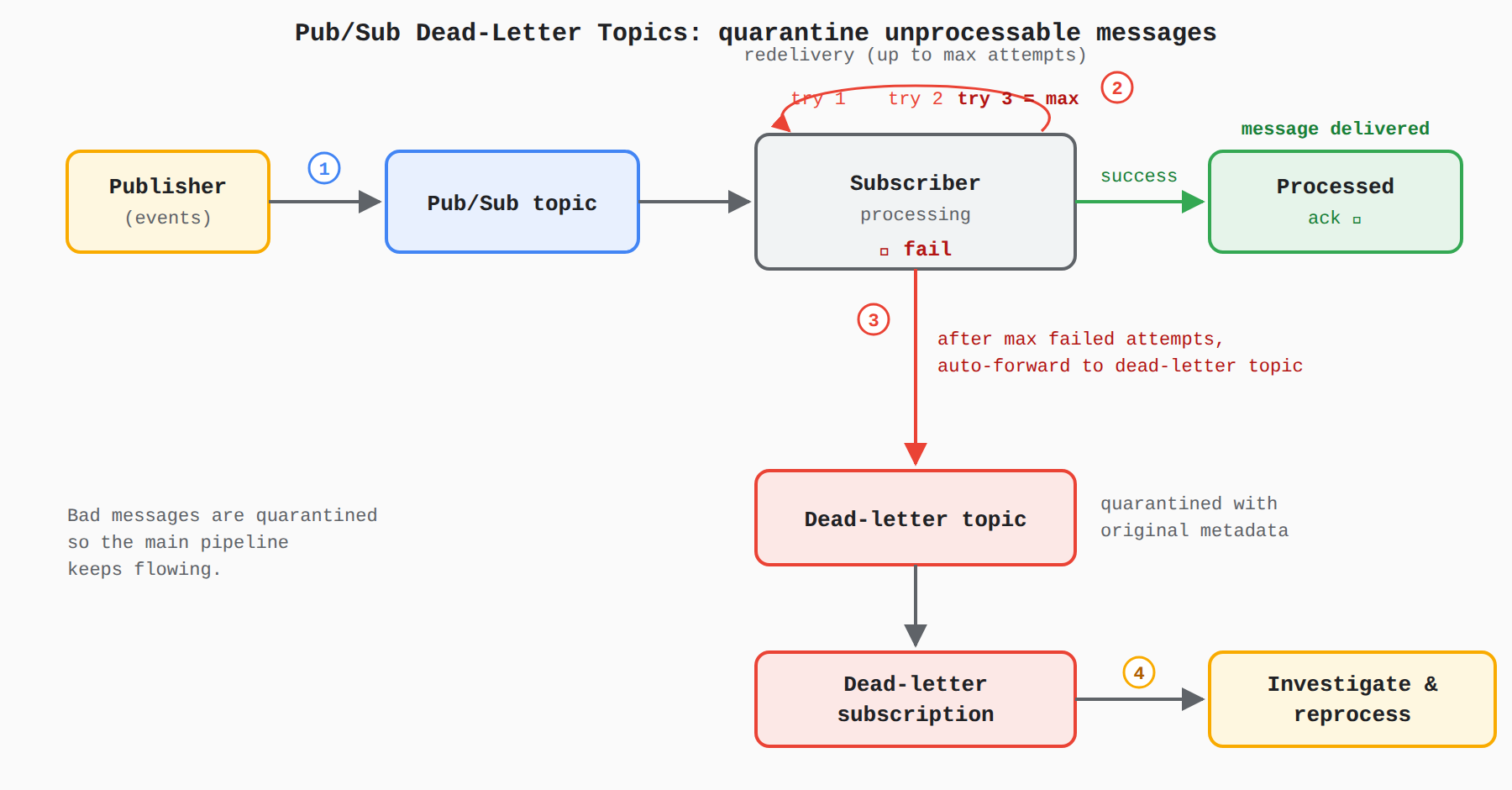
A process flow showing messages moving from a publisher through a Pub/Sub topic to a subscriber. A healthy message is acknowledged and processing continues, while a poison message fails repeated delivery attempts, is auto-forwarded to a dead-letter topic and dead-letter subscription with its metadata preserved, and is then available for investigation and reprocessing.
Cloud Composer, built on Apache Airflow, is used to orchestrate complex recovery workflows. You can design Directed Acyclic Graphs (DAGs) in Cloud Composer to automate the entire recovery process. These workflows can automatically pause a pipeline upon detecting a data quality issue, trigger the recovery procedure (like restoring data from a backup), validate the recovered data, and then resume normal processing. This ensures a consistent, repeatable recovery process instead of relying on error-prone manual steps.
Checkpoint-based reprocessing is a recovery technique that uses saved "safe points" in a data pipeline. If corruption occurs, the pipeline can be restarted from the last valid checkpoint, reprocessing only the data that came after it. This avoids the need to restart the entire job from the beginning. Checkpoints can be established using features like BigQuery table snapshots or by saving the state of Cloud Storage objects at specific times. BigQuery's time travel feature, which lets you query data as it existed up to seven days ago, provides another layer of defense against logical corruption.
Data lineage tracks the origin, movement, and transformation of data throughout its lifecycle. Maintaining clear lineage is critical for forensic analysis when corruption occurs, as it allows you to trace the issue back to its source. In Google Cloud, Cloud Audit Logs record all API calls and modifications to resources. When combined with metadata management tools like Dataplex Universal Catalog, you can build a comprehensive audit trail. This supports both compliance requirements and operational troubleshooting by providing visibility into every step a piece of data has taken.
A process flow of a four-stage data pipeline (Ingest, Transform, Load, BigQuery) where a data batch advances, checkpoints are saved at safe points, corruption is detected at the Load stage, and the pipeline rewinds to the last valid checkpoint, reprocessing only the data after it instead of restarting from the beginning.
The design of any recovery pipeline must align with business requirements for Recovery Time Objective (RTO) and Recovery Point Objective (RPO). RTO defines how quickly a service must be restored after an incident, while RPO defines the maximum acceptable amount of data loss, measured in time. Google Cloud database services like Cloud SQL and Spanner offer point-in-time recovery capabilities, allowing you to restore data to any specific moment within a configurable retention window. Automating recovery with orchestration tools helps meet stringent RTO and RPO targets by minimizing the delay and manual effort involved in a response.
Proactive monitoring and alerting involves setting up systems to detect data issues automatically before they cause downstream problems. The goal is to establish comprehensive observability by monitoring key metrics for data completeness, freshness, and consistency, and then triggering alerts when these metrics cross defined thresholds.
A core part of this strategy is using Cloud Monitoring and Cloud Logging to create custom dashboards and alerts. You should configure alerts for specific failure scenarios, such as data corruption or silent failures where data stops arriving. For example, you can monitor Dataflow pipeline metrics like system_lag (which indicates processing delays) or create custom log-based metrics that track successful record counts. An alert can be set to trigger if the data ingestion rate from a critical source falls below a certain level, enabling a rapid response.
To effectively distinguish real threats from normal variations, you can implement anomaly detection. Google Cloud services can automatically analyze historical metric data (like API error rates or pipeline latency) to establish a behavioral baseline. When current activity deviates significantly from this model, the system can generate a severity-based alert (slight, moderate, or severe). This allows teams to prioritize their response and can even trigger automated mitigation workflows, such as quarantining data or rerunning a failed job.
A complete strategy also integrates security and threat monitoring. This includes enabling curated detection rules that use external threat intelligence to alert on known bad indicators within your data streams. Furthermore, critical audit logs for events like IAM permission changes or network modifications should be monitored with corresponding alerts. By combining operational data quality, security, and threat observability into a single framework, you build a system resilient to a wide range of failures.
A data quality and integrity validation framework consists of automated checks embedded within data pipelines to catch issues like schema drift, unexpected null values, and statistical anomalies. These checks prevent corrupt or incomplete data from propagating through the analytics system.
You can build validation directly into data ingestion engines like Dataflow. Dataflow pipelines can be configured to enforce strict schema contracts on incoming records. If a record contains unexpected null values, mismatched data types, or other schema deviations, the pipeline can route the problematic element to a dead-letter table in BigQuery. This isolates the corrupted data, allowing the main ingestion workload to continue uninterrupted. The quarantined records are preserved with automatic timestamps and error details for later forensic analysis.
For automated data quality oversight, you can leverage Sensitive Data Protection and governance frameworks like Dataplex. Sensitive Data Protection can profile databases to scan for anomalous configurations, sensitive fields, and unexpected data types at a granular level. Dataplex extends this by enabling auto data quality checks that assess the semantic integrity of datasets across your storage systems. This automated governance helps dynamically identify and flag statistical anomalies and policy violations, such as unmasked sensitive values.
The open-source Data Validation Tool (DVT) provides a repeatable, automated method for validating data across different systems like Cloud SQL, Spanner, and BigQuery. This Python-based utility can check for consistency in schemas, row counts, and even column-level data. Integrating DVT with serverless tools like Cloud Run allows for event-driven validation; for instance, a validation check can be triggered automatically immediately after a data load job completes. Deploying these automated tests acts as a final gatekeeper, preventing flawed datasets from moving further down the analytics pipeline.
A Pub/Sub dead-letter topic is a safety mechanism that automatically quarantines messages that fail repeated processing attempts, preventing them from blocking the main pipeline. The quarantined messages retain all original metadata for later investigation, debugging, and potential reprocessing.
Cloud Storage versioning preserves every version of an object stored in a bucket, allowing you to revert to a previous known-good state when corruption is detected. This feature is a core part of a backup strategy, especially when corruption is discovered long after data was processed, and can be combined with cost-effective storage classes like Nearline, Coldline, and Archive for long-term compliant backups.
Cloud Composer is used to orchestrate complex recovery workflows by designing Directed Acyclic Graphs (DAGs) that automate the entire recovery process. These workflows can automatically pause a pipeline upon detecting a data quality issue, trigger recovery procedures like restoring from backup, validate the recovered data, and then resume normal processing, ensuring a consistent, repeatable process instead of manual steps.
Checkpoint-based reprocessing is a recovery technique that uses saved safe points in a data pipeline so that if corruption occurs, the pipeline can be restarted from the last valid checkpoint and reprocess only the data after it. This avoids restarting the entire job from the beginning, and checkpoints can be established using BigQuery table snapshots, saving the state of Cloud Storage objects, or BigQuery's time travel feature which allows querying data as it existed up to seven days ago.
An e-commerce company ingests high-throughput user clickstream events via Cloud Pub/Sub and processes them using a streaming Dataflow pipeline before persisting the records into BigQuery. Upstream mobile application updates have occasionally introduced unannounced schema changes, unexpected null values in mandatory telemetry attributes, and malformed JSON payloads, causing unhandled pipeline exceptions and data corruption in downstream reporting tables.
The data engineering team needs to implement an automated validation framework that detects schema drift and corrupted records in real time, isolates non-conforming payloads without interrupting the processing of valid events, and alerts engineers when anomaly rates exceed predefined thresholds.
Which architecture should the team deploy?
Deploy a Cloud Function subscribed to Pub/Sub to call the Cloud Data Loss Prevention (Cloud DLP) API for schema structural validation before forwarding records to Dataflow
Implement schema validation within a Dataflow DoFn using dead-letter side outputs for malformed or non-conforming records, increment custom pipeline metrics, and emit alerts via Cloud Monitoring
Enable schema auto-detection and ignore unknown values on the BigQuery streaming sink within the Dataflow pipeline to coerce missing and drifted fields automatically
Configure an Cloud Monitoring alert on Dataflow system lag that automatically triggers a Cloud Function to stop the streaming job when lag increases
 StudyCerts
 StudyCerts